


Introduction
Title V, Subtitle A of the Gramm-Leach-Bliley Act (“GLBA”)1 governs the treatment of nonpublic personal information about consumers by financial institutions. Section 502 of the Subtitle, subject to certain exceptions, prohibits a financial institution from disclosing nonpublic personal information about a consumer to nonaffiliated third parties, unless (i) the institution satisfies various notice and opt-out requirements, and (ii) the consumer has not elected to opt out of the disclosure. Section 503 requires the institution to provide notice of its privacy policies and practices to its customers. Section 504 authorizes the issuance of regulations to implement these provisions.
In 2000, the Board of Governors of the Federal Reserve System (“Board”), the Federal Deposit Insurance Corporation (“FDIC”), the National Credit Union Administration (“NCUA”), the Office of the Comptroller of the Currency (“OCC”), and the former Office of Thrift Supervision (“OTS”), published regulations implementing provisions of GLBA governing the treatment of nonpublic personal information about consumers by financial institutions.2
Title X of the Dodd-Frank Act Wall Street Reform and Consumer Protection Act (“Dodd-Frank Act”)3 granted rulemaking authority for most provisions of Subtitle A of Title V of GLBA to the Consumer Financial Protection Bureau (“CFPB”) with respect to financial institutions and other entities subject to the CFPB’s jurisdiction, except securities and futures-related companies and certain motor vehicle dealers. The Dodd-Frank Act also granted authority to the CFPB to examine and enforce compliance with these statutory provisions and their implementing regulations with respect to entities under CFPB jurisdiction.4 In December 2011 the CFPB recodified in Regulation P, 12 CFR Part 1016, the implementing regulations that were previously issued by the Board, the FDIC, the Federal Trade Commission (“FTC”), the NCUA, the OCC, and the former OTS.5
The regulation establishes rules governing duties of a financial institution to provide particular notices and limitations on its disclosure of nonpublic personal information, as summarized below.
- A financial institution must provide notice of its privacy policies and practices, and allow the consumer to opt out of the disclosure of the consumer’s nonpublic personal information to a nonaffiliated third party if the disclosure is outside of the exceptions in sections 13, 14, or 15 of the regulation. If the financial institution provides the consumer’s nonpublic personal information to a nonaffiliated third party under the exception in section 13, it must provide notice of its privacy policies and practices to the consumer. Under the exception in section 13, the financial institution must also enter into a contractual agreement with the third party that prohibits the third party from disclosing or using the information other than to perform services for the institution or functions on the institution’s behalf, including use under an exception in sections 14 or 15 in the ordinary course of business to carry out those services or functions. If the financial institution complies with these requirements, it is not required to provide an opt out notice.
- Regardless of whether a financial institution shares nonpublic personal information, the institution must provide notice of its privacy policies and practices to its customers.
- A financial institution generally may not disclose consumer account numbers to any nonaffiliated third party for marketing purposes.
- A financial institution must follow redisclosure and reuse limitations on any nonpublic personal information it receives from a nonaffiliated financial institution.
In general, the privacy notice must describe a financial institution’s policies and practices with respect to collecting and disclosing nonpublic personal information about a consumer to both affiliated and nonaffiliated third parties. Also, the notice must provide a consumer a reasonable opportunity to direct the institution generally not to share nonpublic personal information about the consumer (that is, to “opt out”) with nonaffiliated third parties other than as permitted by exceptions under the regulation (for example, sharing for everyday business purposes, such as processing transactions and maintaining customers’ accounts, and in response to properly executed governmental requests). The privacy notice must also provide, where applicable under the Fair Credit Reporting Act (“FCRA”), a notice and an opportunity for a consumer to opt out of certain information sharing among affiliates.
Section 728 of the Financial Services Regulatory Relief Act of 2006 required the four federal banking agencies (the Board, the FDIC, the OCC, and the former OTS) and four additional federal regulatory agencies (the Commodity Futures Trading Commission (“CFTC”), the FTC, the NCUA, and the Securities and Exchange Commission (“SEC”)) to develop a model privacy form that financial institutions may rely on as a safe harbor to provide disclosures under the privacy rules.
On December 1, 2009, the eight federal agencies jointly released a voluntary model privacy form designed to make it easier for consumers to understand how financial institutions collect and share nonpublic personal information.6 The final rule adopting the model privacy form was effective on December 31, 2009.
On October 28, 2014, the CFPB published a final rule amending the requirements regarding financial institutions’ provision of their annual disclosures of privacy policies and practices to customers by creating an alternative delivery method that financial institutions can use under certain circumstances.7 The amendment was effective immediately upon publication. The alternative delivery method allows a financial institution to provide an annual privacy notice by posting the annual notice on its web site, if the financial institution meets certain conditions.
As of December 4, 2015, section 75001 of the Fixing America’s Surface Transportation Act8 (“FAST Act”) amended section 503 of GLBA to establish an exception to the annual privacy notice requirements whereby a financial institution that meets certain criteria is not required to provide an annual privacy notice to customers. The amendment was effective upon enactment.
There are fewer requirements to qualify for the exception to providing an annual privacy notice pursuant to the FAST Act GLBA amendments than there are to qualify to use the CFPB’s alternative delivery method; any institution that meets the requirements for using the alternative delivery method is effectively excepted from delivering an annual privacy notice.
Definitions and Key Concepts
In discussing the duties and limitations imposed by the regulation, a number of key concepts are used. These concepts include “financial institution”; “nonpublic personal information”; “nonaffiliated third party”; the “opt out” right and the exceptions to that right; and “consumer” and “customer.” Each concept is briefly discussed below. A more complete explanation of each appears in the regulation.
Financial Institution: A “financial institution” is any institution the business of which is engaging in activities that are financial in nature or incidental to such financial activities, as determined by section 4(k) of the Bank Holding Company Act of 1956. Financial institutions can include banks, securities brokers and dealers, insurance underwriters and agents, finance companies, mortgage bankers, and travel agents.9
Nonpublic personal information: “Nonpublic personal information” generally is any information that is not publicly available and that:
- a consumer provides to a financial institution to obtain a financial product or service from the institution;
- results from a transaction between the consumer and the institution involving a financial product or service; or
- a financial institution otherwise obtains about a consumer in connection with providing a financial product or service.
Information is publicly available if an institution has a reasonable basis to believe that the information is lawfully made available to the general public from government records, widely distributed media, or legally required disclosures to the general public. Examples include information in a telephone book or a publicly recorded document, such as a mortgage or security interest filing.
Nonpublic personal information may include individual items of information as well as lists of information. For example, nonpublic personal information may include names, addresses, phone numbers, social security numbers, income, credit score, and information obtained through Internet collection devices (i.e., cookies).
There are special rules regarding lists. Publicly available information would be treated as nonpublic if it were included on a list of consumers derived from nonpublic personal information. For example, a list of the names and addresses of a financial institution’s depositors would be nonpublic personal information even though the same names and addresses might be published in local telephone directories, because the list is derived from the fact that a person has a deposit account with an institution, which is not publicly available information.
However, if the financial institution has a reasonable basis to believe that certain customer relationships are a matter of public record, then any list of these relationships would be considered publicly available information. For instance, a list of mortgage customers from public mortgage records would be considered publicly available information. The institution could provide a list of such customers, and include on that list any other publicly available information it has about those customers without having to provide notice or opt out.
Nonaffiliated third party: A “nonaffiliated third party” is any person except a financial institution’s affiliate or a person employed jointly by a financial institution and a company that is not the institution’s affiliate. An “affiliate” of a financial institution is any company that controls, is controlled by, or is under common control with the financial institution.
Opt Out Right and Exceptions:
The Right—Consumers must be given the right to “opt out” of, or prevent, a financial institution from disclosing nonpublic personal information about them to a nonaffiliated third party unless an exception to that right applies. The exceptions are detailed in sections 13, 14, and 15 of the regulation and described below.
As part of the opt out right, consumers must be given a reasonable opportunity and a reasonable means to opt out. What constitutes a reasonable opportunity to opt out depends on the circumstances surrounding the consumer’s transaction, but a consumer must be provided a reasonable amount of time to exercise the opt out right. For example, it would be reasonable if the financial institution allows 30 days from the date of mailing a notice or 30 days after customer acknowledgement of an electronic notice for an opt out direction to be returned. What constitutes a reasonable means to opt out may include check-off boxes, a reply form, or a toll-free telephone number. It is not reasonable to require a consumer to write his or her own letter as the only means to opt out.
The Exceptions
Exceptions to the opt out right are detailed in sections 13, 14, and 15 of the regulation. Financial institutions need not comply with opt-out requirements if they limit disclosure of nonpublic personal information:
- Section 13: To a nonaffiliated third party to perform services for the financial institution or to function on its behalf, including marketing the institution’s own products or services or those offered jointly by the institution and another financial institution. The exception is permitted only if the financial institution provides an initial notice of these arrangements and by contract prohibits the third party from disclosing or using the information for other than the specified purposes. However, if the service or function is covered by the exceptions in section 14 or 15 (discussed below), the financial institution does not have to comply with the disclosure and confidentiality requirements of section 13.
- Section 14: As necessary to effect, administer, or enforce a transaction that a consumer requests or authorizes, or under certain other circumstances relating to existing relationships with customers. Disclosures under this exception could be in connection with the audit of credit information, administration of a rewards program, or provision of an account statement.
- Section 15: For specified other disclosures that a financial institution normally makes, such as to protect against or prevent actual or potential fraud; to the financial institution’s attorneys, accountants, and auditors; or to comply with applicable legal requirements, such as the disclosure of information to regulators.
Consumer and Customer:
The distinction between consumers and customers is significant because financial institutions have additional disclosure duties with respect to customers. Under the regulation, all customers are consumers, but not all consumers are customers.
A “consumer” is an individual, or that individual’s legal representative, who obtains or has obtained a financial product or service from a financial institution that is to be used primarily for personal, family, or household purposes.
A “financial service” includes, among other things, a financial institution’s evaluation or brokerage of information that the institution collects in connection with a request or an application from a consumer for a financial product or service. For example, a financial service includes a lender’s evaluation of an application for a consumer loan or for opening a deposit account even if the application is ultimately rejected or withdrawn.
Consumers who are not customers are entitled to an initial privacy and opt out notice before the financial institution shares nonpublic personal information with nonaffiliated third parties outside of the exceptions in sections 13, 14, and 15. Consumers who are not customers are entitled to an initial privacy notice before the financial institution shares nonpublic personal information with a nonaffiliated third party under the exception in section 13. Under the exception in section 13, the financial institution must also enter into a contractual agreement with the third party that prohibits the third party from disclosing or using the information other than to perform services for the institution or functions on the institution’s behalf, including use under an exception in sections 14 or 15 in the ordinary course of business to carry out those services or functions. If a financial institution complies with these requirements, it is not required to provide an opt out notice.
A “customer” is a consumer who has a “customer relationship” with a financial institution. A “customer relationship” is a continuing relationship between a consumer and a financial institution under which the institution provides one or more financial products or services to the consumer that are to be used primarily for personal, family, or household purposes.
- For example, a customer relationship may be established when a consumer engages in one of the following activities with a financial institution:
- maintains a deposit or investment account;
- obtains a loan;
- enters into a lease of personal property; or
- obtains financial, investment, or economic advisory services for a fee.
Customers are entitled to initial and annual privacy notices regardless of the information disclosure practices of their financial institution unless an exception to the annual privacy notice requirement applies.
There is a special rule for loans. When a financial institution sells the servicing rights to a loan to another financial institution, the customer relationship transfers with the servicing rights. However, any information on the borrower retained by the institution that sells the servicing rights must be accorded the protections due any consumer.
- Note that isolated transactions alone will not cause a consumer to be treated as a customer. For example, if an individual purchases a bank check from a financial institution where the person has no account, the individual will be a consumer but not a customer of that institution because he or she has not established a customer relationship. Likewise, if an individual uses the ATM of a financial institution where the individual has no account, even repeatedly, the individual will be a consumer, but not a customer of that institution.
Financial Institution Duties
The regulation establishes specific duties and limitations for a financial institution based on its activities. Financial institutions that intend to disclose nonpublic personal information outside the exceptions in sections 13, 14, and 15 will have to provide opt out rights to their customers and to consumers who are not customers. All financial institutions have an obligation to provide initial and annual notices of their privacy policies and practices to their customers (unless an exception to the annual privacy notice requirement applies) and to provide an initial notice to consumers who are not customers before disclosing nonpublic personal information to a nonaffiliated third party other than under sections 14 and 15. All financial institutions must abide by the regulatory limits on the disclosure of account numbers to nonaffiliated third parties and on the redisclosure and reuse of nonpublic personal information received from nonaffiliated financial institutions.
A brief summary of financial institution duties and limitations appears below. A more complete explanation of each appears in the regulation.
Notice and Opt Out Duties to Consumers:
Before a financial institution discloses nonpublic personal information about any of its consumers to a nonaffiliated third party, and an exception in section 14 or 15 does not apply, then the financial institution must provide to the consumer:
- an initial notice of its privacy policies and practices;
- an opt out notice (including, among other things, a reasonable means to opt out); and
- a reasonable opportunity, before the financial institution discloses the information to the nonaffiliated third party, to opt out.
Before a financial institution discloses nonpublic personal information about a consumer to a nonaffiliated third party under the exception in section 13, the financial institution must provide to the consumer an initial notice of its privacy policies and practices. Under the exception in section 13, the financial institution must also enter into a contractual agreement with the third party that prohibits the third party from disclosing or using the information other than to perform services for the institution or functions on the institution’s behalf, including use under an exception in sections 14 or 15 in the ordinary course of business to carry out those services or functions. If a financial institution complies with these requirements, it is not required to provide an opt out notice.
The financial institution may not disclose any nonpublic personal information to nonaffiliated third parties except under the enumerated exceptions unless these notices have been provided and the consumer has not opted out (where applicable). Additionally, the institution must provide a revised notice before the financial institution begins to share a new category of nonpublic personal information or shares information with a new category of nonaffiliated third party in a manner that was not described in the previous notice.
Note that a financial institution need not comply with the initial and opt-out notice requirements for consumers who are not customers if the institution limits disclosure of nonpublic personal information to the exceptions in sections 14 and 15. A financial institution that discloses nonpublic personal information about a consumer to a nonaffiliated third party under the exception in section 13 must provide an initial notice. Under the exception in section 13, the financial institution must also enter into a contractual agreement with the third party that prohibits the third party from disclosing or using the information other than to perform services for the institution or functions on the institution’s behalf, including use under an exception in sections 14 or 15 in the ordinary course of business to carry out those services or functions. If these requirements are met, the financial institution is not required to provide an opt out notice.
Notice Duties to Customers:
In addition to the duties described above, there are several duties unique to customers. In particular, regardless of whether the institution discloses or intends to disclose nonpublic personal information, a financial institution must provide notice to its customers of its privacy policies and practices at various times.
- A financial institution must provide an initial notice of its privacy policies and practices to each customer, not later than the time a customer relationship is established. Section 4(e) of the regulation describes the exceptional cases in which delivery of the notice is allowed subsequent to the establishment of the customer relationship.
- A financial institution must provide an annual notice at least once in any period of 12 consecutive months during the continuation of the customer relationship unless an exception to the annual privacy notice requirement applies.
- Generally, new privacy notices are not required for each new product or service. However, a financial institution must provide a new notice to an existing customer when the customer obtains a new financial product or service from the institution, if the initial or annual notice most recently provided to the customer was not accurate with respect to the new financial product or service.
- When a financial institution does not disclose nonpublic personal information (other than as permitted under section 14 and section 15 exceptions) and does not reserve the right to do so, the institution has the option of providing a simplified notice.
Requirements for Notices
Clear and Conspicuous. Privacy notices must be clear and conspicuous, meaning they must be reasonably understandable and designed to call attention to the nature and significance of the information contained in the notice. The regulation does not prescribe specific methods for making a notice clear and conspicuous, but does provide examples of ways in which to achieve the standard, such as the use of short explanatory sentences or bullet lists, and the use of plain-language headings and easily readable typeface and type size. Privacy notices also must accurately reflect the institution’s privacy practices.
Delivery Rules. Privacy notices must be provided so that each recipient can reasonably be expected to receive actual notice in writing, or if the consumer agrees, electronically. To meet this standard, a financial institution could, for example, (1) hand-deliver a printed copy of the notice to its consumers, (2) mail a printed copy of the notice to a consumer’s last known address, or (3) for the consumer who conducts transactions electronically, post the notice on the institution’s web site and require the consumer to acknowledge receipt of the notice as a necessary step to completing the transaction.
For customers only, a financial institution must provide the initial notice (as well as any annual notice and any revised notice) so that a customer can retain or subsequently access the notice. A written notice satisfies this requirement. For customers who obtain financial products or services electronically, and agree to receive their notices on the institution’s web site, the institution may provide the current version of its privacy notice on its web site.
As of October 28, 2014, a financial institution may use an alternative delivery method for providing annual privacy notices to customers through posting the annual notices on their web sites if: (1) no opt out rights are triggered by the financial institution’s information sharing practices under GLBA or under FCRA section 603, and opt out notices required by FCRA section 624 and Subpart C of Regulation V have previously been provided, if applicable, or the annual privacy notice is not the only notice provided to satisfy those requirements; (2) certain information included in the annual privacy notice has not changed since the previous notice; and (3) the financial institution uses the model form provided in the regulation as its annual privacy notice. In order to use this alternative delivery method, an institution must: (1) insert a clear and conspicuous statement at least once per year on an account statement, coupon book, or a notice or disclosure the institution issues under any provision of law that informs customers that the annual privacy notice is available on the institution’s web site, that the institution will mail the notice to customers who request it by calling a specific telephone number, and that the notice has not changed; (2) continuously post the current privacy notice in a clear and conspicuous manner on a page on its web site, on which the only content is the privacy notice, without requiring the customer to provide any information such as a login name or password or agree to any conditions to access the web site; and (3) mail its current privacy notice to those customers who request it by telephone within ten calendar days of the request.
As of December 4, 2015, pursuant to the FAST Act’s GLBA amendment, a financial institution is not required to provide an annual privacy notice to its customers if it: (1) solely shares nonpublic personal information in accordance with the provisions of GLBA sections 502(b)(2) (corresponding to Regulation P section 1016.13) or 502(e) (corresponding to Regulation P sections 1016.14 and .15) or regulations prescribed under GLBA section 504(b); and (2) has not changed its policies and practices with regard to disclosing nonpublic personal information since its most recent disclosure to its customers that was made in accordance with GLBA section 503. An institution that at any time fails to comply with either of the criteria is not eligible for the exception and is required to provide an annual privacy notice to its customers.
Notice Content. A privacy notice must contain specific disclosures. However, a financial institution may provide to consumers who are not also customers a “short form” initial notice together with an opt out notice stating that the institution’s privacy notice is available upon request and explaining a reasonable means for the consumer to obtain it. The following is a list of disclosures regarding nonpublic personal information that institutions must provide in their privacy notices, as applicable:
- categories of information collected;
- categories of information disclosed;
- categories of affiliates and nonaffiliated third parties to whom the institution may disclose information;
- policies and practices with respect to the treatment of former customers’ information;
- categories of information disclosed to nonaffiliated third parties that perform services for the institution or functions on the institution’s behalf and categories of third parties with whom the institution has contracted (Section 13);
- an explanation of the opt out right and methods for opting out;
- any opt out notices that the institution must provide under the FCRA with respect to affiliate information sharing;
- policies and practices for protecting the security and confidentiality of information; and
- a statement that the institution makes disclosures to other nonaffiliated third parties for everyday business purposes or as permitted by law (Sections 14 and 15).
Model Privacy Form. The Appendix to the regulation contains the model privacy form. A financial institution can use the model form to obtain a “safe harbor” for compliance with the content requirements for notifying consumers of its information-sharing practices and their right to opt out of certain sharing practices. To obtain the safe harbor, the institution must provide a model form in accordance with the instructions set forth in the Appendix of the regulation. Additionally, institutions using the alternative delivery method for providing annual privacy notices to customers must use the model form.
Limitations on Disclosure of Account Numbers (section 12):
A financial institution must not disclose an account number or similar form of access number or access code for a credit card, deposit, or transaction account to any nonaffiliated third party (other than a consumer reporting agency) for use in telemarketing, direct mail marketing, or other marketing through electronic mail to the consumer.
The disclosure of encrypted account numbers without an accompanying means of decryption, however, is not subject to this prohibition. The regulation also expressly allows disclosures by a financial institution to its agent to market the institution’s own products or services (although the financial institution must not authorize the agent to directly initiate charges to the customer’s account). The regulation also does not bar a financial institution from disclosing account numbers to participants in private-label or affinity card programs, if the participants are identified to the customer when the customer enters the program.
Redisclosure and Reuse Limitations on Nonpublic Personal Information Received (section 11):
If a financial institution receives nonpublic personal information from a nonaffiliated financial institution, its disclosure and use of the information is limited.
- For nonpublic personal information received under a section 14 or 15 exception, the financial institution is limited to:
- Disclosing the information to the affiliates of the financial institution from which it received the information;
- Disclosing the information to its own affiliates, who may, in turn, disclose and use the information only to the extent that the financial institution can do so; and
- Disclosing and using the information pursuant to a section 14 or 15 exception (for example, an institution receiving information for account processing could disclose the information to its auditors).
- For nonpublic personal information received other than under a section 14 or 15 exception, the recipient’s use of the information is unlimited, but its disclosure of the information is limited to:
- Disclosing the information to the affiliates of the financial institution from which it received the information;
- Disclosing the information to its own affiliates, who may, in turn disclose the information only to the extent that the financial institution can do so; and
- Disclosing the information to any other person, if the disclosure would be lawful if made directly to that person by the financial institution from which it received the information. For example, an institution that received a customer list from another financial institution could disclose the list in accordance with the privacy policy of the financial institution that provided the list, subject to any opt out election or revocation by the consumers on the list, and in accordance with appropriate exceptions under sections 14 and 15.
Other Matters
Fair Credit Reporting Act
The regulation does not modify, limit, or supersede the operation of the FCRA.
State Law
The regulation does not supersede, alter, or affect any state statute, regulation, order, or interpretation, except to the extent that it is inconsistent with the regulation. A state statute, regulation, order, or interpretation is consistent with the regulation if the protection it affords any consumer is greater than the protection provided under the regulation, as determined by the CFPB, on its own motion or upon the petition of any interested party, after consultation with the agency or authority with jurisdiction under section 505(a) of GLBA over either the person who initiated the complaint or that is the subject of the complaint.
Guidelines Regarding Protecting Customer Information
The regulation requires a financial institution to disclose its policies and practices for protecting the confidentiality, security, and integrity of nonpublic personal information about consumers (whether or not they are customers). The disclosure need not describe these policies and practices in detail, but instead may describe in general terms who is authorized to have access to the information and whether the institution has security practices and procedures in place to ensure the confidentiality of the information in accordance with the institution’s policies.
The four federal banking agencies published guidelines, pursuant to section 501(b) of GLBA, that address steps a financial institution should take in order to protect customer information. The guidelines relate only to information about customers, rather than all consumers. Compliance examiners should consider the findings of a 501(b) inspection during the compliance examination of a financial institution for purposes of evaluating the accuracy of the institution’s disclosure regarding information security.
Examination Objectives
- To assess the quality of a financial institution’s compliance management policies, procedures, and internal controls for implementing the regulation, specifically ensuring consistency between what the financial institution tells consumers in its notices about its policies and practices and what it actually does.
- To determine the reliance that can be placed on a financial institution’s policies, procedures, and internal controls for monitoring the institution’s compliance with the regulation.
- To determine a financial institution’s compliance with the regulation, specifically in meeting the following requirements:
- Providing to customers notices of its privacy policies and practices that are timely, accurate, clear and conspicuous, and delivered so that each customer can reasonably be expected to receive actual notice;
- Disclosing nonpublic personal information to nonaffiliated third parties, other than under an exception, after first meeting the applicable requirements for giving consumers notice and the right to opt out;
Appropriately honoring consumer opt out directions;
Lawfully using or disclosing nonpublic personal information received from a nonaffiliated financial institution; and
Disclosing account numbers only according to the limits in the regulation.
- To initiate effective corrective actions when violations of law are identified, or when policies, procedures, or internal controls are deficient.
Examination Procedures10
A. Through discussions with management and review of available information, identify the institution’s information sharing practices (and changes to those practices) with affiliates and nonaffiliated third parties; how it treats nonpublic personal information; and how it administers opt-outs. Consider the following as appropriate:
- Notices (initial, annual, revised, opt out, short-form, and simplified);
- Institutional privacy policies, procedures, and internal controls, including those to:
- Process requests for nonpublic personal information, including requests for aggregated information;
- Deliver notices to consumers;
- Manage consumer opt out directions (e.g., designating files, allowing a reasonable time to opt out, providing new opt out and privacy notices when necessary, receiving opt out directions, handling joint account holders);
- Prevent the unlawful disclosure and use of the information received from nonaffiliated financial institutions; and prevent the unlawful disclosure of account numbers;
- Information sharing agreements between the institution and affiliates and service agreements or contracts between the institution and nonaffiliated third parties either to obtain or provide information or services;
- Complaint logs, telemarketing scripts, and any other information obtained from nonaffiliated third parties (NOTE: review telemarketing scripts to determine whether the contractual terms set forth under section 13 are met and whether the institution is disclosing account number information in violation of section 12);
- Categories of nonpublic personal information collected from or about consumers in obtaining a financial product or service (e.g., in the application process for deposit, loan, or investment products; for an over-the-counter purchase of a bank check; from E‑banking products or services, including information collected electronically through Internet cookies; or through ATM transactions);
- Categories of nonpublic personal information shared with, or received from, each nonaffiliated third party;
- Consumer complaints regarding the treatment of nonpublic personal information, including those received electronically;
- Records that reflect the bank’s categorization of its information sharing practices under Sections 13, 14, 15, and outside of these exceptions; and
- Results of a 501(b) inspection (used to determine the accuracy of the institution’s privacy disclosures regarding information security).
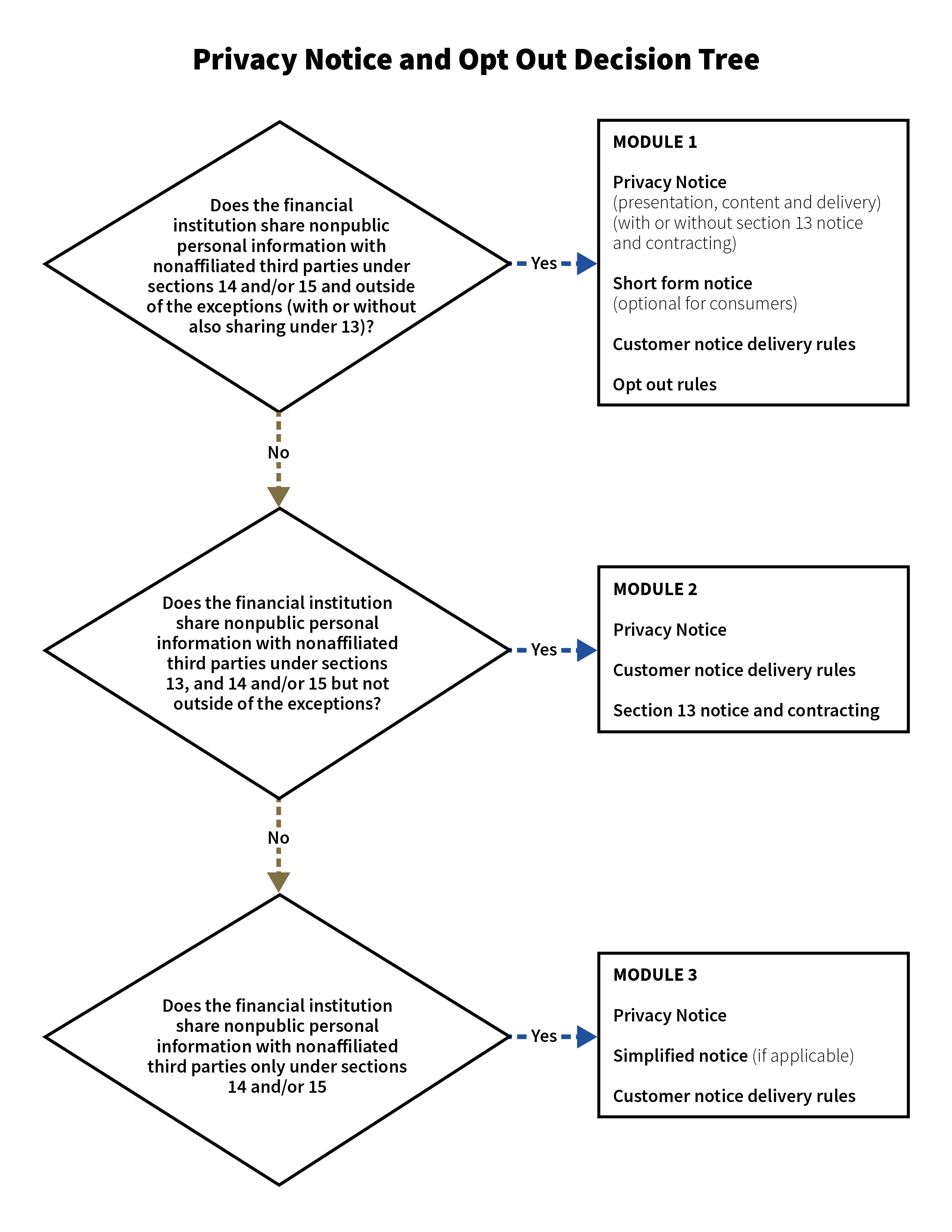
B . Use the information gathered from step A to work through the “Privacy Notice and Opt Out Decision Tree” (Attachment A). Identify which module(s) of procedures is (are) applicable.
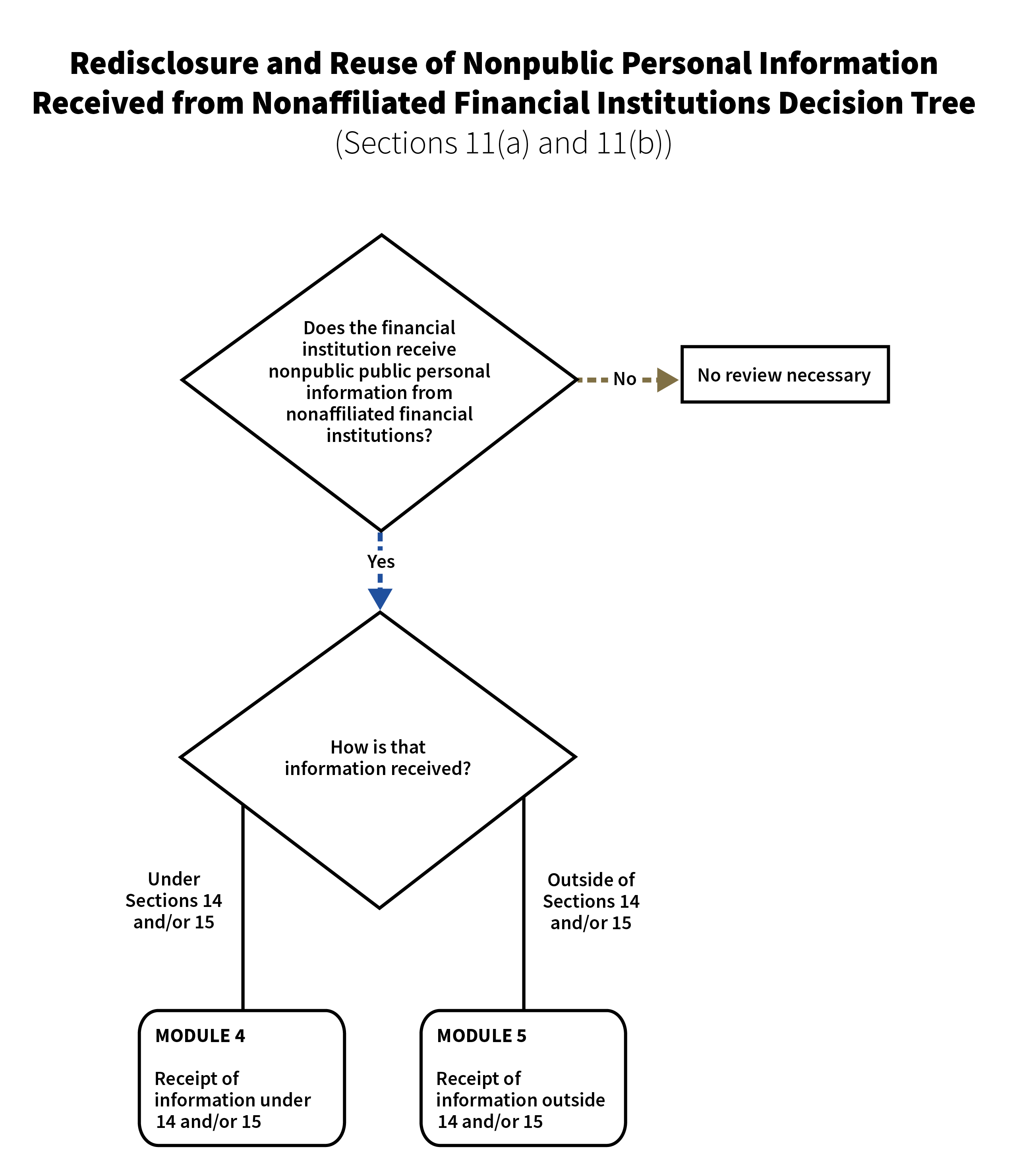
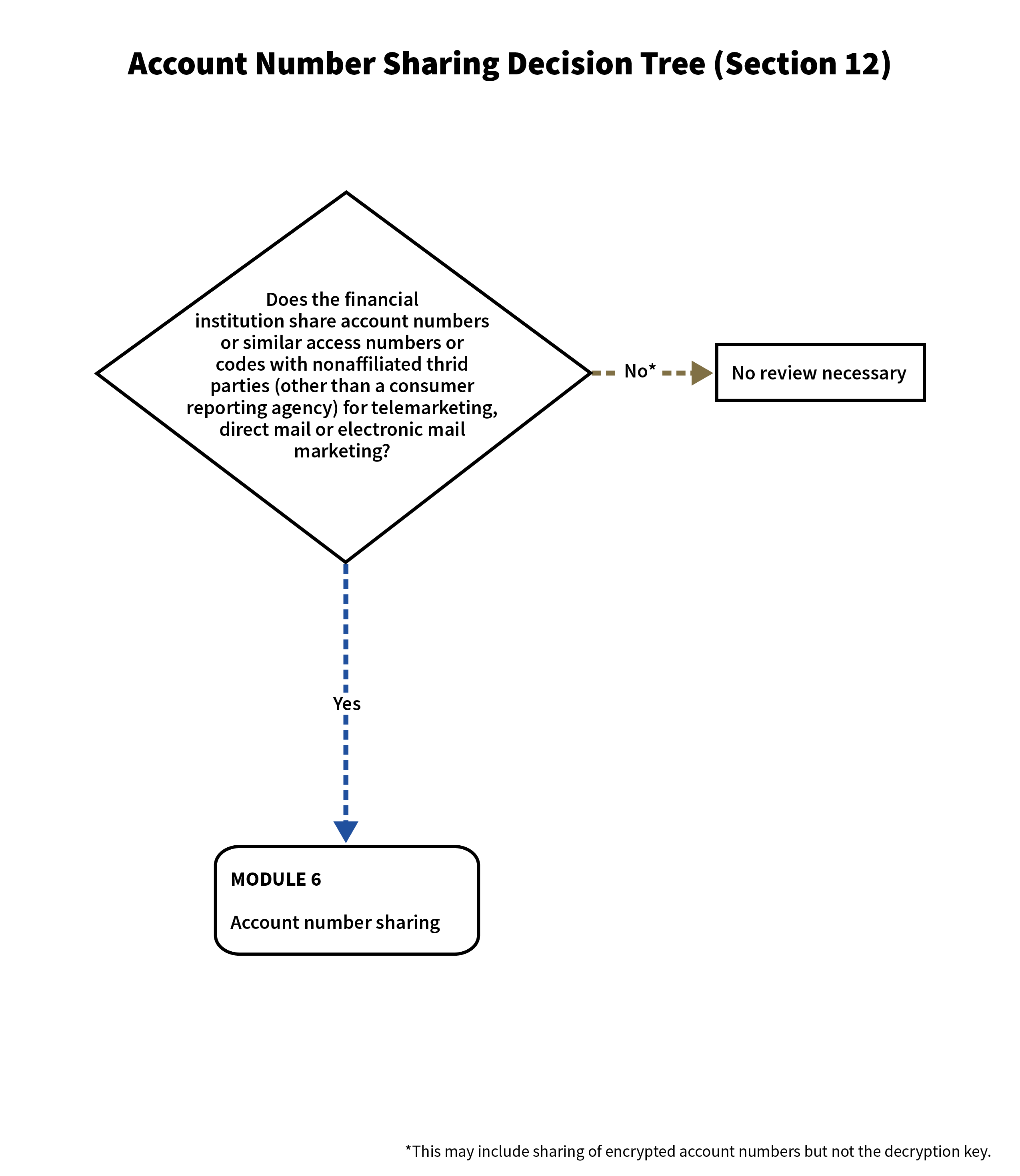
C. Use the information gathered from step A to work through the Redisclosure and Reuse and Account Number Sharing Decision Trees, as necessary (Attachments B and C). Identify which module is applicable.
D. Determine the adequacy of the financial institution’s policies, procedures, and internal controls to ensure compliance with the regulation as applicable. Consider the following:
- Sufficiency of internal policies, procedures, and internal controls, including review of new products and services and controls over servicing arrangements and marketing arrangements;
- Effectiveness of management information systems, including the use of technology for monitoring, exception reports, and standardization of forms and procedures;
- Frequency and effectiveness of monitoring procedures;
- Adequacy and regularity of the institution’s training program;
- Suitability of the compliance audit program for ensuring that:
- The procedures address all regulatory provisions as applicable;
- The work is accurate and comprehensive with respect to the institution’s information sharing practices;
- The frequency is appropriate;
- Conclusions are appropriately reached and presented to responsible parties;
- Steps are taken to correct deficiencies and to follow-up on previously identified deficiencies; and
- Knowledge level of management and personnel.
E. Ascertain areas of risk associated with the financial institution’s sharing practices (especially those within Section 13 and those that fall outside of the exceptions) and any weaknesses found within the compliance management program. Keep in mind any outstanding deficiencies identified in the audit for follow-up when completing the modules.
F. Based on the results of the foregoing initial procedures and discussions with management, determine which procedures if any should be completed in the applicable module, focusing on areas of particular risk. The selection of procedures to be employed depends upon the adequacy of the institution’s compliance management system and level of risk identified. Each module contains a series of general instructions to verify compliance, cross-referenced to cites within the regulation. Additionally, there are cross-references to a more comprehensive checklist, which the examiner may use if needed to evaluate compliance in more detail.
G. Evaluate any additional information or documentation discovered during the course of the examination according to these procedures. Note that this may reveal new or different sharing practices necessitating reapplication of the Decision Trees and completion of additional or different modules.
H. Formulate conclusions.
Summarize all findings.
- For violation(s) noted, determine the cause by identifying weaknesses in internal controls, compliance review, training, management oversight, or other areas.
- Identify action needed to correct violations and to address weaknesses in the institution’s compliance system, as appropriate.
- Discuss findings with management and obtain a commitment for corrective action.
Module 1
Sharing nonpublic personal information with nonaffiliated third parties under Sections 14 and/or 15 and outside of the exceptions (with or without also sharing under Section 13).
NOTE: Financial institutions whose practices fall within this category engage in the most expansive degree of information sharing permissible. Consequently, these institutions are held to the most comprehensive compliance standards imposed by the regulation.
NOTE: As of December 4, 2015, a financial institution is not required to provide an annual privacy notice to its applicable customers if it: (1) solely shares nonpublic personal information in accordance with the provisions of GLBA sections 502(b)(2) (corresponding to Regulation P section 1016.13) or 502(e) (corresponding to Regulation P sections 1016.14 and .15) or regulations prescribed under GLBA section 504(b); and (2) has not changed its policies and practices with regard to disclosing nonpublic personal information since its most recent disclosure to its customers that was made in accordance with GLBA section 503. A financial institution that at any time fails to comply with either of the criteria is not eligible for the exception and is required to provide an annual privacy notice to its customers.
- Disclosure of Nonpublic Personal Information
- Select a sample of third party relationships with nonaffiliated third parties and obtain a sample of information shared between the institution and the third party both inside and outside of the exceptions. The sample should include a cross-section of relationships but should emphasize those that are higher risk in nature as determined by the initial procedures. Perform the following comparisons to evaluate the financial institution’s compliance with disclosure limitations.
- Compare the categories of information shared and with whom the information was shared to those stated in the privacy notice and verify that what the institution tells consumers (both customers and those who are not customers) in its notices about its policies and practices in this regard and what the institution actually does are consistent. (Sections 6,10)
- Compare the information shared to a sample of opt out directions and verify that only nonpublic personal information covered under the exceptions or from consumers (customers and those who are not customers) who chose not to opt out is shared (Section 10).
- f the financial institution also shares information under Section 13, obtain and review contracts with nonaffiliated third parties that perform services for the financial institution not covered by the exceptions in section 14 or 15. Determine whether the contracts prohibit the third party from disclosing or using the information other than to carry out the purposes for which the information was disclosed (Section 13(a))
- Select a sample of third party relationships with nonaffiliated third parties and obtain a sample of information shared between the institution and the third party both inside and outside of the exceptions. The sample should include a cross-section of relationships but should emphasize those that are higher risk in nature as determined by the initial procedures. Perform the following comparisons to evaluate the financial institution’s compliance with disclosure limitations.
- Presentation, Content, and Delivery of Privacy Notices
- Review the financial institution’s initial, annual and revised notices, as well as any short-form notices that the institution may use for consumers who are not customers. Determine whether or not these notices:
- Are clear and conspicuous (Sections 3(b), 4(a), 5(a)(1), 8(a)(1));
- Accurately reflect the institution’s policies and practices. (Sections 4(a), 5(a)(1), 8(a)(1))
NOTE: this includes policies and practices disclosed in the notices that exceed regulatory requirements; and - Include, and adequately describe, all required items of information and contain examples as applicable (Section 6). Note that if the institution shares under nonpublic personal information under Section 13 the notice provisions for that section shall also apply.
- If the model privacy form is used, determine that it reflects the institution’s policies and practices. For institutions seeking a safe harbor for compliance with the content requirements of the regulation, verify that the notice has the proper content and is in the proper format as specified in the Appendix A of the regulation.
Through discussions with management, review of the institution’s policies, procedures, and internal controls and a sample of electronic or written consumer records where available, determine if the institution has adequate policies, procedures, and internal controls in place to provide notices to consumers, as appropriate. Assess the following:
Timeliness of delivery (Sections 4(a), 7(c), 8(a)); and
- Reasonableness of the method of delivery (e.g., by hand; by mail; electronically, if the consumer agrees; or as a necessary step of a transaction) (Section 9).
- For customers only, review the timeliness of delivery (Sections 4(d), 4(e), 5(a)), means of delivery of annual notice (Section 9(c)), and accessibility of or ability to retain the notice (Section 9(e)).
- Review the financial institution’s initial, annual and revised notices, as well as any short-form notices that the institution may use for consumers who are not customers. Determine whether or not these notices:
- Opt Out Right
- Review the financial institution’s opt out notices. An opt out notice may be combined with the institution’s privacy notices. Regardless, determine whether the opt out notices:
- Are clear and conspicuous (Sections 3(b) and 7(a)(1));
- Accurately explain the right to opt out (Section 7(a)(1));
- Include and adequately describe the three required items of information (the institution’s policy regarding disclosure of nonpublic personal information, the consumer’s opt out right, and the means to opt out) (Section 7(a)(1)); and
- Describe how the institution treats joint relationships, as applicable (Section 7(d)).
- Through discussions with management, review of the institution’s policies, procedures, and internal controls and a sample of electronic or written consumer records where available, determine if the institution has adequate policies, procedures, and internal controls in place to provide notices to consumers, as appropriate. Assess the following:
- Timeliness of delivery (Section 10(a)(1));
- Reasonableness of the method of delivery (e.g., by hand; by mail; electronically, if the consumer agrees; or as a necessary step of a transaction) (Section 9).
- Reasonableness of the opportunity to opt out (the time allowed to and the means by which the consumer may opt out) (Sections 10(a)(1)(iii), 10(a)(3)); and
- Adequacy of procedures to implement and track the status of a consumer’s (customers and those who are not customers) opt out direction, including those of former customers (Section 7(e), (f), (g)).
- Review the financial institution’s opt out notices. An opt out notice may be combined with the institution’s privacy notices. Regardless, determine whether the opt out notices:
- Checklist Cross References—Module1
| Regulation Section | Subject | Checklist Questions |
|---|---|---|
| 4(a); 6(a, b, c, e); and 9(a, b, g) | Privacy notices (presentation, content, and delivery) | 2, 8-11, 14, 18, 35, 36, 41 |
| 4(a, c, d, e); 5; and 9(c, e) | Customer notice delivery rules | 1, 3-7, 37, 39 |
| 13 | Section 13 notice and contracting rules (as applicable) | 12, 48 |
| 6(d) | Short form notice rules (optional for consumers only) | 15-17 |
| 7; 8; and 10 | Opt out rules | 19-34, 42-44 |
| 14, 15 | Exceptions | 49- 50 |
Module 2
Sharing nonpublic personal information with nonaffiliated third parties under Sections 13, and 14 and/or 15 but not outside of these exceptions
NOTE: As of December 4, 2015, a financial institution is not required to provide an annual privacy notice to its applicable customers if it: (1) solely shares nonpublic personal information in accordance with the provisions of GLBA sections 502(b)(2) (corresponding to Regulation P section 1016.13) or 502(e) (corresponding to Regulation P sections 1016.14 and .15) or regulations prescribed under GLBA section 504(b); and (2) has not changed its policies and practices with regard to disclosing nonpublic personal information since its most recent disclosure to its customers that was made in accordance with GLBA section 503. A financial institution that at any time fails to comply with either of the criteria is not eligible for the exception and is required to provide an annual privacy notice to its customers.
- Disclosure of Nonpublic Personal Information
- Select a sample of third party relationships with nonaffiliated third parties and obtain a sample of information shared between the institution and the third party. The sample should include a cross-section of relationships but should emphasize those that are higher risk in nature as determined by the initial procedures. Perform the following comparisons to evaluate the financial institution’s compliance with disclosure limitations.
- Compare the information shared and with whom the information was shared to ensure that the institution accurately categorized its information sharing practices and is not sharing nonpublic personal information outside the exceptions. (Sections 13, 14, 15)
- Compare the categories of information shared and with whom the information was shared to those stated in the privacy notice and verify that what the institution tells consumers in its notices about its policies and practices in this regard and what the institution actually does are consistent. (Sections 10, 6)
- If the model privacy form is used, determine that it reflects the institution’s policies and practices. For institutions seeking a safe harbor for compliance with the content requirements of the regulation, verify that the notice has the proper content and is in the proper format as specified in the Appendix of the regulation.
- Review contracts with nonaffiliated third parties that perform services for the financial institution not covered by the exceptions in section 14 or 15. Determine whether the contracts adequately prohibit the third party from disclosing or using the information other than to carry out the purposes for which the information was disclosed (Section 13(a)).
- Select a sample of third party relationships with nonaffiliated third parties and obtain a sample of information shared between the institution and the third party. The sample should include a cross-section of relationships but should emphasize those that are higher risk in nature as determined by the initial procedures. Perform the following comparisons to evaluate the financial institution’s compliance with disclosure limitations.
- Presentation, Content, and Delivery of Privacy Notices
- Review the financial institution’s initial and annual privacy notices. Determine whether or not they:
- Are clear and conspicuous (Sections 3(b), 4(a), 5(a)(1));
- Accurately reflect the institution’s policies and practices (Sections 4(a), 5(a)(1)). Note, this includes policies and practices disclosed in the notices that exceed regulatory requirements; and
- Include, and adequately describe, all required items of information and contain examples as applicable. (Sections 6, 13)
- Through discussions with management, review of the institution’s policies, procedures, and internal controls and a sample of electronic or written consumer records where available, determine if the institution has adequate policies, procedures, and internal controls in place to provide notices to consumers, as appropriate. Assess the following:
- Timeliness of delivery (Section 4(a)); and
- Reasonableness of the method of delivery (e.g., by hand; by mail; electronically, if the consumer agrees; as a necessary step of a transaction; or pursuant to the alternative delivery method) (Section 9).
- For customers only, review the timeliness of delivery (Sections 4(d), 4(e), and 5(a)), means of delivery of annual notice Section 9(c)), and accessibility of or ability to retain the notice (Section 9(e)).
- Review the financial institution’s initial and annual privacy notices. Determine whether or not they:
- Checklist Cross References—Module 2
| Regulation Section | Subject | Checklist Questions |
|---|---|---|
| 4(a); 6(a, b, c, e); and 9(a, b, g) | Privacy notices (presentation, content, and delivery) | 2, 8-11, 14, 18, 35, 36, 41 |
| 4(a, c, d, e); 5; and 9(c, e) | Customer notice delivery rules | 1, 3-7, 37, 39 |
| 13 | Section 13 notice and contracting rules | 12, 48 |
| 14, 15 | Exceptions | 49-51 |
Module 3
Sharing nonpublic personal information with nonaffiliated third parties only under Sections 14 and/or 15.
NOTE: This module applies only to customers.
NOTE: As of December 4, 2015, a financial institution is not required to provide an annual privacy notice to its applicable customers if it: (1) solely shares nonpublic personal information in accordance with the provisions of GLBA sections 502(b)(2) (corresponding to Regulation P section 1016.13) or 502(e) (corresponding to Regulation P sections 1016.14 and .15) or regulations prescribed under GLBA section 504(b); and (2) has not changed its policies and practices with regard to disclosing nonpublic personal information since its most recent disclosure to its customers that was made in accordance with GLBA section 503. A financial institution that at any time fails to comply with either of the criteria is not eligible for the exception and is required to provide an annual privacy notice to its customers.
- Disclosure of Nonpublic Personal Information
- Select a sample of third party relationships with nonaffiliated third parties and obtain a sample of information shared between the financial institution and the third party.
- Compare the information shared and with whom the information was shared to ensure that the institution accurately states its information sharing practices and is not sharing nonpublic personal information outside the exceptions.
- Select a sample of third party relationships with nonaffiliated third parties and obtain a sample of information shared between the financial institution and the third party.
- Presentation, Content, and Delivery of Privacy Notices
- Obtain and review the financial institution’s initial and annual notices, as well as any simplified notice that the institution may use. Note that the institution may only use the simplified notice when it does not also share nonpublic personal information with affiliates outside of Section 14 and 15 exceptions. Determine whether or not these notices:
- Are clear and conspicuous (Sections 3(b), 4(a), 5(a)(1));
- Accurately reflect the institution’s policies and practices (Sections 4(a), 5(a)(1)). Note, this includes practices disclosed in the notices that exceed regulatory requirements; and
- Include, and adequately describe, all required items of information (Section 6).
- If the model privacy form is used, determine that it reflects the institution’s policies and practices. For institutions seeking a safe harbor for compliance with the content requirements of the regulation, verify that the notice has the proper content and is in the proper format as specified in the Appendix of the regulation.
- Through discussions with management, review of the institution’s policies, procedures, and internal controls and a sample of electronic or written customer records where available, determine if the institution has adequate policies, procedures, and internal controls in place to provide notices to customers, as appropriate. Assess the following:
- Timeliness of delivery (Sections 4(a), 4(d), 4(e), 5(a)); and
- Reasonableness of the method of delivery (e.g., by hand; by mail; electronically, if the customer agrees; as a necessary step of a transaction; or pursuant to the alternative delivery method) (Section 9) and accessibility of or ability to retain the notice (Section 9(e)).
- Obtain and review the financial institution’s initial and annual notices, as well as any simplified notice that the institution may use. Note that the institution may only use the simplified notice when it does not also share nonpublic personal information with affiliates outside of Section 14 and 15 exceptions. Determine whether or not these notices:
- Checklist Cross References—Module 3
| Regulation Section | Subject | Checklist Questions |
|---|---|---|
| 4(a, d, e); 5; and 9 | Customer notice delivery process | 1, 3,-7, 35-41 |
| 6 | Customer notice content and presentation | 8-11, 14, 18 |
| 6(c)(5); | Simplified notice content (optional) | 13 |
| 14, 15 | Exceptions | 49-51 |
Module 4
Redisclosure and Reuse of nonpublic personal information received from a nonaffiliated financial institution under Sections 14 and/or 15.
- Through discussions with management and review of the institution’s policies, procedures, and internal controls, determine whether the institution has adequate policies, procedures, and internal controls to prevent the unlawful redisclosure and reuse of the information where the institution is the recipient of nonpublic personal information (Section 11(a)).
- Select a sample of information received from nonaffiliated financial institutions, to evaluate the financial institution’s compliance with redisclosure and reuse limitations.
- Verify that the institution’s redisclosure of the information was only to affiliates of the financial institution from which the information was obtained or to the institution’s own affiliates, except as otherwise allowed in the step 2 below (Section 11(a)(1)(i) and (ii)).
- Verify that the institution only uses and shares the information pursuant to an exception in Sections 14 and 15 (Section 11(a)(1)(iii)).
- Checklist Cross References—Module 4
| Regulation Section | Subject | Checklist Questions |
|---|---|---|
| 11(a) | Reuse and disclosure presentation | 45 |
| 14, 15 | Exceptions | 49-51 |
Module 5
Redisclosure of nonpublic personal information received from a nonaffiliated financial institution outside of Sections 14 and 15.
- Through discussions with management and review of the institution’s policies, procedures, and internal controls, determine whether the institution has adequate policies, procedures, and internal controls to prevent the unlawful redisclosure of the information where the institution is the recipient of nonpublic personal information (Section 11(b)).
- Select a sample of information received from nonaffiliated financial institutions and shared with others to evaluate the financial institution’s compliance with redisclosure limitations.
- Verify that the institution’s redisclosure of the information was only to affiliates of the financial institution from which the information was obtained or to the institution’s own affiliates, except as otherwise allowed in the step 2 below (Section 11(b)(1)(i) and (ii)).
- If the institution shares information with entities other than those under step 1 above, verify that the institution’s information sharing practices conform to those in the nonaffiliated financial institution’s privacy notice (Section 11(b)(1)(iii)).
- Also, review the procedures used by the institution to ensure that the information sharing reflects the opt out status of the consumers of the nonaffiliated financial institution (Sections 10, 11(b)(1)(iii)).
- Checklist Cross References—Module 5
| Regulation Section | Subject | Checklist Questions |
|---|---|---|
| 11(b) | Redisclosure | 46 |
Module 6
Account number sharing
- If available, review a sample of telemarketer scripts used when making sales calls to determine whether the scripts indicate that the telemarketers have the account numbers of the institution’s consumers (Section 12(a)).
- Obtain and review a sample of contracts with agents or service providers to whom the financial institution discloses account numbers for use in connection with marketing the institution’s own products or services. Determine whether the institution shares account numbers with nonaffiliated third parties only to perform marketing for the institution’s own products and services. Ensure that the contracts do not authorize these nonaffiliated third parties to directly initiate charges to the accounts (Section 12(b)(1)).
- Obtain a sample of materials and information provided to the consumer upon entering a private label or affinity credit card program. Determine if the participants in each program are identified to the customer when the customer enters into the program (Section 12(b)(2)).
- Checklist Cross References—Module 6
| Regulation Section | Subject | Checklist Questions |
|---|---|---|
| 12 | Account number sharing | 47 |
References
CFPB Part 1016: Privacy of Consumer Financial Information
FIL 01-106: Privacy of Consumer Financial Information (Includes a link to an FDIC Press Release that included FDIC Staff Response to Questions Regarding the Privacy of Consumer Financial Information
Examination Checklist | Response |
|---|---|
| Examination Checklist - Subpart A | |
| Initial Privacy Notice | |
| Yes / No / NA |
| Yes / No / NA |
| Yes / No / NA |
| |
| Yes / No / NA |
| Yes / No / NA |
| Yes / No / NA |
| Annual Privacy Notice | |
| Yes / No / NA |
| Yes / No / NA |
| Content of Privacy Notice | |
| |
| Yes / No / NA |
| Yes / No / NA |
| Yes / No / NA |
| Yes / No / NA |
| Yes / No / NA |
| Yes / No / NA |
|
|
| Yes / No / NA |
| Yes / No / NA |
| |
| Yes / No / NA |
| Yes / No / NA |
| Yes / No / NA |
| Yes / No / NA |
| |
| Yes / No / NA |
| Yes / No / NA |
| Yes / No / NA |
| Yes / No / NA |
| |
| Yes / No / NA |
| Yes / No / NA |
| Yes / No / NA |
| |
| Yes / No / NA |
| Yes / No / NA |
| Yes / No / NA |
| |
| Yes / No / NA |
| Yes / No / NA |
| Yes / No / NA |
| Yes / No / NA |
| |
| Yes / No / NA |
| Yes / No / NA |
| Yes / No / NA |
| |
| Yes / No / NA |
| Yes / No / NA |
| Yes / No / NA |
| |
| Yes / No / NA |
| Yes / No / NA |
| |
| Yes / No / NA |
| Yes / No / NA |
| Opt Out Notice | |
| Yes / No / NA |
| |
| Yes / No / NA |
| Yes / No / NA |
| Yes / No / NA |
| |
| Yes / No / NA |
| Yes / No / NA |
| Yes / No / NA |
| Yes / No / NA |
| |
| Yes / No / NA |
| Yes / No / NA |
| Yes / No / NA |
| Yes / No / NA |
| Yes / No / NA |
| Yes / No / NA |
| Yes / No / NA |
| |
| Yes / No / NA |
| Yes / No / NA |
| |
| Yes / No / NA |
| Yes / No / NA |
| Yes / No / NA |
| Yes / No / NA |
| Yes / No / NA |
| Yes / No / NA |
| Yes / No / NA |
| Yes / No / NA |
| Revised Notices | |
| |
| Yes / No / NA |
| Yes / No / NA |
| Yes / No / NA |
| Yes / No / NA |
| |
| Yes / No / NA |
| Yes / No / NA |
| Yes / No / NA |
| Delivery Methods | |
| Yes / No / NA |
| |
| Yes / No / NA |
| Yes / No / NA |
| Yes / No / NA |
| Yes / No / NA |
| |
| Yes / No / NA |
| Yes / No / NA |
conditions:
| Yes / No / NA |
| Yes / No / NA |
| |
| Yes / No / NA |
| Yes / No / NA |
| Yes / No / NA |
| Yes / No / NA |
| Examination Checklist – Subpart B | |
| Limits on Disclosures to Nonaffiliated Third Parties | |
| |
| Yes / No / NA |
| Yes / No / NA |
| Yes / No / NA |
| Yes / No / NA |
| |
| Yes / No / NA |
| Yes / No / NA |
| Yes / No / NA |
| Yes / No / NA |
| Limits on Redisclosure and Reuse of Information | |
| |
| Yes / No / NA |
| Yes / No / NA |
| Yes / No / NA |
| |
| Yes / No / NA |
| Yes / No / NA |
| Yes / No / NA |
| Limits on Sharing Account Number Information for Marketing Purposes | |
| |
| Yes / No / NA |
| Yes / No / NA |
| Examination Checklist - Subpart C | |
| Exception to Opt Out Requirements for Providers and Joint Marketing | |
| |
| Yes / No / NA |
| Yes / No / NA |
| Yes / No / NA |
| |
| Yes / No / NA |
| Yes / No / NA |
| Yes / No / NA |
| |
| Yes / No / NA |
| Yes / No / NA |
| Yes / No / NA |
| Yes / No / NA |
| Yes / No / NA |
| Yes / No / NA |
| Yes / No / NA |
| |
| Yes / No / NA |
| Yes / No / NA |
| Yes / No / NA |
| Other Exceptions to Notice and Opt Out Requirements | |
| |
| Yes / No / NA |
| Yes / No / NA |
| Yes / No / NA |
| Yes / No / NA |
| Yes / No / NA |
| Yes / No / NA |
| Yes / No / NA |
| Yes / No / NA |
| Yes / No / NA |
| Yes / No / NA |
| Yes / No / NA |
| Yes / No / NA |
| Yes / No / NA |
| Yes / No / NA |
| 1 | 15 U.S.C. Sections6801-6809. |
| 2 | The NCUA published its final rule in the Federal Register on May 18, 2000 (65 FR 31722). The Board, the FDIC, the OCC, and the former OTS jointly published their final rules on June 1, 2000 (65 FR 35162). |
| 3 | Dodd-Frank Wall Street Reform and Consumer Protection Act of 2010, Pub. L. No. 111-203, Title X, 124 Stat. 1983 (2010). |
| 4 | Dodd-Frank Act Sections 1002(12)(J), 1024(b)-(c), and 1025(b)-(c); 12 U.S.C. Sections5481(12)(J), 5514(b)-(c), and 5515(b)-(c). Section 1002(12)(J) of the Dodd-Frank Act, however, excluded financial institutions’ information security safeguards under GLBA section 501(b) from the CFPB’s rulemaking, examination, and enforcement authority. |
| 5 | 76 FR 79025 (Dec. 21, 2011). Pursuant to GLBA, the FTC retains rulemaking authority over any financial institution that is a person described in 12 U.S.C. Section5519 (with certain statutory exceptions, the FTC generally retains rulemaking authority for motor vehicle dealers predominantly engaged in the sale and servicing of motor vehicles, the leasing and servicing of motor vehicles, or both). |
| 6 | 74 FR 62890. |
| 7 | 79 FR 64057. |
| 8 | Fixing America’s Surface Transportation Act of 2015, Pub. L. No. 114-94 (2015), 129 Stat. 1312 (2015). |
| 9 | Certain functionally regulated subsidiaries, such as brokers, dealers, and investment advisers, are subject to GLBA implementing regulations issued by the SEC. Other functionally regulated subsidiaries, such as futures commission merchants, commodity trading advisors, commodity pool operators, and introducing brokers in commodities, are subject to GLBA implementing regulations issued by the CFTC. Insurance entities may be subject to privacy regulations issued by their respective state insurance authorities. |
| 10 | These reflect the interagency examination procedures in their entirety. |