


Background
The Home Mortgage Disclosure Act1 requires certain financial institutions to collect, report, and disclose information about their mortgage lending activity. HMDA was originally enacted by the Congress in 1975 and is implemented by Regulation C (12 CFR Part 1003).
HMDA was enacted given public concern over credit shortages in certain neighborhoods. In particular, Congress believed that some financial institutions had contributed to the decline of various geographic areas through their failure to provide adequate home financing to qualified applicants on reasonable terms and conditions. Thus, one statutory purpose of HMDA is to provide the public with information that will help show whether financial institutions are serving the housing credit needs of the communities and neighborhoods in which they are located. A second statutory purpose is to aid public officials in distributing public sector investment so as to attract private investment to areas where it is needed. Finally, the Financial Institutions Reform, Recovery, and Enforcement Act of 1989 (FIRREA) amended HMDA to require the collection and disclosure of data about applicant and borrower characteristics to assist in identifying possible discriminatory lending patterns and enforcing antidiscrimination statutes.
As the name implies, HMDA is a disclosure law that relies upon public scrutiny for its effectiveness. It does not prohibit any specific activity of lenders, and it does not establish a quota system of mortgage loans to be made in any geographic area.
Between 1988 and 1992, Congress amended HMDA’s coverage. Coverage was expanded in the FIRREA amendments to include many independent nondepository mortgage lenders, in addition to the previously covered banks, savings associations, and credit unions. Coverage of independent mortgage bankers was further expanded by the Federal Deposit Insurance Corporation Improvement Act of 1991 HMDA amendments. For a more detailed discussion of the history of HMDA, see the Federal Financial Institutions Examination Council’s (FFIEC) website at www.ffiec.gov/hmda/history2.htm.
Prior to the Dodd-Frank Wall Street Reform and Consumer Protection Act of 2010 (Dodd-Frank Act), HMDA required financial institutions to report data regarding applications, loan originations, and loan purchases, as well as certain requests under a pre-approval program (as defined in Regulation C). HMDA also required financial institutions to report certain applicant and borrower demographic data, such as ethnicity, race, gender, and gross income. In addition, the reporting of certain pricing information and the type of purchaser was required. Data was reported in a “register” reporting format, compiled by supervisory agencies, and disclosed to the public.
The Dodd-Frank Act amended HMDA to, among other things, require reporting of additional data points, transfer HMDA rulemaking authority from the Board of Governors of the Federal Reserve System (FRB) to the Consumer Financial Protection Bureau (Bureau), and provide the Bureau with authority to mandate collection, recording, and reporting of such other information as the Bureau may require.2 In August 2014, the Bureau proposed amendments to Regulation C to implement the Dodd-Frank Act changes; to require collection, recording, and reporting of additional information to further HMDA’s purposes; and to modernize the manner in which covered financial institutions report HMDA data. The Bureau published a final rule amending Regulation C in October 2015 (2015 HMDA Rule).3 The Bureau published a final rule further amending Regulation C in September 2017 to facilitate implementation of the 2015 HMDA Rule (2017 HMDA Rule).4
Beginning in 2018, as discussed further below, the 2015 HMDA Rule requires that financial institutions continue to report data regarding applications, loan originations, and loan purchases. The Bureau’s 2015 HMDA Rule changed: (1) the definition of a financial institution that is subject to Regulation C; (2) the types of transactions that are subject to Regulation C; (3) the data that financial institutions are required to collect, record, and report pursuant to Regulation C; and (4) the processes for reporting and disclosing HMDA data. The data are submitted electronically to the Bureau on behalf of the appropriate Federal agency associated with the reporter, and most of the data are made available to the public on both an aggregate and a loan-level basis.5
On May 24, 2018, the President signed the Economic Growth, Regulatory Relief, and Consumer Protection Act (2018 Act) into law.6 Effective May 24, 2018, Section 104(a) of the 2018 Act created partial exemptions from some of HMDA’s requirements for certain covered institutions. On August 31, 2018, the Bureau issued an interpretive and procedural rule (2018 HMDA Rule) to implement and clarify Section 104(a) of the 2018 Act (2018 HMDA Rule). The 2018 HMDA Rule was published in the Federal Register on September 7, 2018.7
On April 16, 2020, the Bureau issued a final rule to increase the coverage threshold related to closed-end mortgage loan activity, among other changes (2020 HMDA Rule). The 2020 HMDA Rule was published in the Federal Register on May 12, 2020.8 Effective July 1, 2020, the origination threshold for coverage with respect to closed-end mortgage loans increased from at least 25 originations to at least 100 originations in each of the preceding two calendar years.
The Federal supervisory agencies use HMDA data to support a variety of activities.9 For example, some Federal supervisory agencies use HMDA data as part of their fair lending examination process, and other agencies use HMDA data in conducting Community Reinvestment Act (CRA) performance evaluations.10 Moreover, HMDA disclosures provide the public with information on the home mortgage lending activities of particular reporting entities and on activity in their communities. These disclosures are used by local, State, and Federal officials to evaluate housing trends and issues and by community organizations to monitor financial institution lending patterns. Because HMDA data serve numerous important purposes, validating the accuracy of HMDA data is a key element of the Federal supervisory agencies’ examination activities.
Coverage
A. Institutional Coverage
Institutional Coverage Generally
An institution is required to comply with Regulation C only if it is a financial institution as that term is defined in Regulation C. The definition of financial institution includes both depository financial institutions and nondepository financial institutions, as those terms are separately defined in Regulation C. 12 CFR 1003.2(g).
An institution uses these two definitions, which are outlined below, as coverage tests to determine whether it is a financial institution that is required to comply with Regulation C. For the purpose of these examination procedures, the term financial institution refers to an institution that is either a depository financial institution or a nondepository financial institution that is subject to Regulation C.
Institutional Coverage Tests
Depository Financial Institutions
A bank, savings association, or credit union is a depository financial institution and subject to Regulation C if it meets ALL of the following:
- Asset-Size Threshold. On the preceding December 31, the bank, savings association, or credit union had assets in excess of the asset-size threshold published annually in the Federal Register, as included in the Official Interpretations, 12 CFR Part 1003, Comment 2(g)-2, and posted on the Bureau’s website. 12 CFR 1003.2(g)(1)(i). The phrase “preceding December 31” refers to the December 31 immediately preceding the current calendar year. For example, in 2019, the preceding December 31 is December 31, 2018. Comment 2(g)-1.
Location Test. On the preceding December 31, the bank, savings association, or credit union had a home or branch office located in a metropolitan statistical area (MSA). 12 CFR 1003.2(g)(1)(ii).
For purposes of this location test, a branch office for a bank, savings association, or credit union is an office: (a) of the bank, savings association, or credit union (b) that is considered a branch by the institution’s Federal or State supervisory agency. For purposes of Regulation C, an automated teller machine or other free-standing electronic terminal is not a branch office regardless of whether the supervisory agency would consider it a branch. 12 CFR 1003.2(c)(1). A branch office of a credit union is any office where member accounts are established or loans are made, whether or not a Federal or State agency has approved the office as a branch. Comment 2(c)(1)-1.
- Loan-Activity Test. During the preceding calendar year, the bank, savings association, or credit union originated at least one home purchase loan or refinancing of a home purchase loan secured by a first lien on a one-to-four-unit dwelling. 12 CFR 1003.2(g)(1)(iii). For more information on whether a loan is secured by a dwelling, is a home purchase loan, or is a refinancing, see 12 CFR 1003.2(f), (j), and (p) and associated commentary.
- Federally Related Test. The bank, savings association, or credit union:
- Is federally insured; or
- Is federally regulated; or
- Originated at least one home purchase loan or refinancing of a home purchase loan that was secured by a first lien on a one-to-four-unit dwelling and also (i) was insured, guaranteed, or supplemented by a Federal agency or (ii) was intended for sale to the Federal National Mortgage Association (Fannie Mae) or the Federal Home Loan Mortgage Corporation (Freddie Mac). 12 CFR 1003.2(g)(1)(iv).
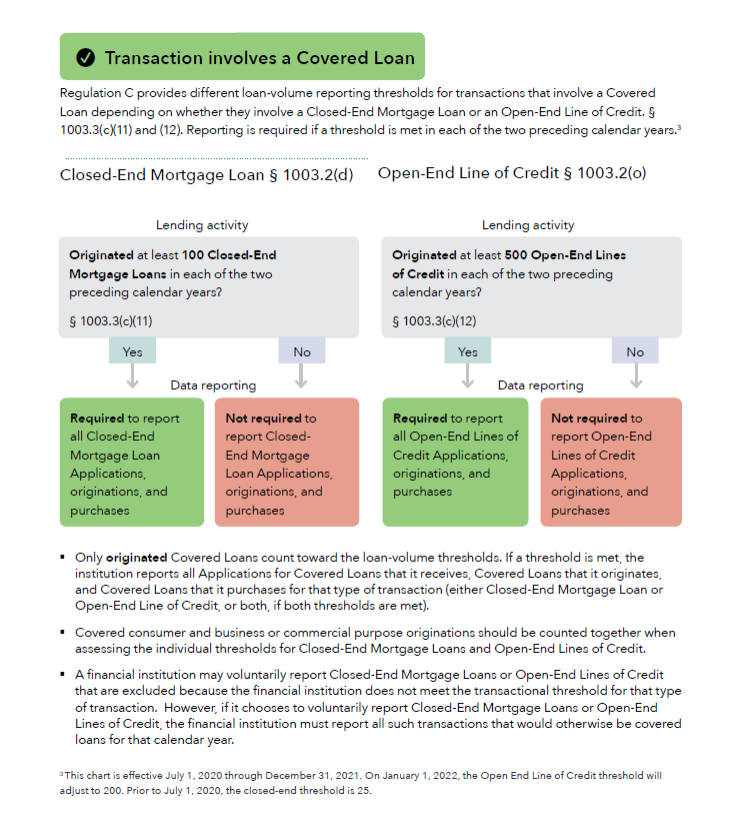
- Loan-Volume Thresholds. The bank, savings association, or credit union meets or exceeds either the closed-end mortgage loan or the open-end line of credit loan-volume threshold in each of the two preceding calendar years.
- A bank, savings association, or credit union that originated at least 100 closed-end mortgage loans in each of the two preceding calendar years, or originated at least 500 open-end lines of credit in each of the two preceding calendar years meets or exceeds the loan-volume threshold.
When the bank, savings association, or credit union determines whether it meets these loan-volume thresholds, it does not count transactions excluded by 12 CFR 1003.3(c)(1) through (10) and (13). 12 CFR 1003.2(g)(1)(v). Closed-end mortgage loans, open-end lines of credit, and these excluded transactions are discussed below in Transactional Coverage.
When determining if it meets the loan-volume thresholds, a bank, savings association, or credit union only counts closed-end mortgage loans and open-end lines of credit that it originated. Only one institution is deemed to have originated a specific closed-end mortgage loan or open-end line of credit under Regulation C, even if two or more institutions are involved in the origination process. Only the institution that is deemed to have originated the transaction under Regulation C counts it for purposes of the loan-volume threshold. Comment 2(g)-5; see also comments 4(a)-2 through -4. These requirements are discussed below in Transactions Involving Multiple Entities.
Regulation C also includes a separate test to ensure that financial institutions that meet only the closed-end mortgage loan threshold are not required to report their open-end lines of credit, and that financial institutions that meet only the open-end line of credit threshold are not required to report their closed-end mortgage loans. 12 CFR 1003.3(c)(11) and (12).
Nondepository Financial Institutions
Under Regulation C, a for-profit mortgage-lending institution other than a bank, savings association, or credit union is a nondepository financial institution and subject to Regulation C if it meets BOTH of the following:
Location Test. The institution had a home or branch office in a metropolitan statistical area (MSA) on the preceding December 31. 12 CFR 1003.2(g)(2)(i). The phrase “preceding December 31” refers to the December 31 immediately preceding the current calendar year. For example, in 2019, the preceding December 31 is December 31, 2018. Comment 2(g)-1.
For purposes of this location test, a branch office of a nondepository financial institution is any one of the institution’s offices at which the institution takes from the public applications for covered loans. A nondepository financial institution is also deemed to have a branch office in an MSA or metropolitan division (MD) if, in the preceding calendar year, it received applications for, originated, or purchased five or more covered loans related to property located in that MSA or MD, even if it does not have an office in that MSA. 12 CFR 1003.2(c)(2). Covered loans and applications for covered loans are discussed below in Transactional Coverage.
- Loan-Volume Thresholds. The institution meets or exceeds either the closed-end mortgage loan threshold or the open-end line of credit threshold in each of the two preceding calendar years.
- An institution that originated at least 100 closed-end mortgage loans in each of the two preceding calendar years, or originated at least 500 open-end lines of credit in each of the two preceding calendar years meets or exceeds the loan-volume threshold.
When an institution determines whether it meets the loan-volume thresholds, it does not count transactions excluded by 12 CFR 1003.3(c)(1) through (10) and (13). 12 CFR 1003.2(g)(2)(ii). Closed-end mortgage loans, open-end lines of credit, and these excluded transactions are discussed below in Transactional Coverage.
When determining if it meets the loan-volume thresholds, an institution only counts closed-end mortgage loans and open-end lines of credit that it originated. Only one institution is deemed to have originated a specific closed-end mortgage loan or open-end line of credit under Regulation C, even if two or more institutions are involved in the origination process. Only the institution that is deemed to have originated the transaction under Regulation C counts it for purposes of the loan-volume threshold. Comment 2(g)-5. See also comments 4(a)-2 through -4. These requirements are discussed below in Transactions with Multiple Entities.
Regulation C also includes a separate test to ensure that financial institutions that meet only the closed-end mortgage loan threshold are not required to report their open-end lines of credit, and that financial institutions that meet only the open-end line of credit threshold are not required to report their closed-end mortgage loans. 12 CFR 1003.3(c)(11)–(12).
B. Exemptions Based on State Law
Regulation C provides that financial institutions may apply for an exemption from coverage. Specifically, the Bureau may exempt a State-chartered or State-licensed financial institution if the Bureau determines that the financial institution is subject to a State disclosure law that contains requirements substantially similar to those imposed by Regulation C and adequate enforcement provisions. Any State-licensed or State-chartered financial institution or association of such institutions may apply to the Bureau for an exemption. An exempt institution shall submit the data required by State law to its State supervisory agency. 12 CFR 1003.3(a). A financial institution that loses its exemption must comply with Regulation C beginning with the calendar year following the year for which it last reported data under the State disclosure law. 12 CFR 1003.3(b).
C. Transaction Coverage
A financial institution is required to collect, record, and report information only for transactions that are subject to Regulation C.
Covered Loans
A covered loan can be either a closed-end mortgage loan or an open-end line of credit, but an excluded transaction cannot be a covered loan. 12 CFR 1003.2(e).
To determine if a transaction is subject to Regulation C, a financial institution should first determine whether the loan or line of credit involved in the transaction is either a closed-end mortgage loan or an open-end line of credit. See Closed-End Mortgage Loans and Open-End Lines of Credit, below. If the loan or line of credit is neither a closed-end mortgage loan nor an open-end line of credit, the transaction does not involve a covered loan, and the financial institution is not required to report information related to the transaction. If the loan or line of credit is either a closed-end mortgage loan or an open-end line of credit, the financial institution must determine if the closed-end mortgage loan or open-end line of credit is an excluded transaction. See Excluded Transactions, below. If the closed-end mortgage loan or the open-end line of credit is an excluded transaction, it is not a covered loan, and the financial institution is not required to report information related to the transaction. If the loan or line of credit is a closed-end mortgage loan or an open-end line of credit and is not an excluded transaction, the financial institution may be required to report information related to the transaction. See Reportable Activity, below.
Closed-End Mortgage Loans and Open-End Lines of Credit
A closed-end mortgage loan is:
- An extension of credit;
- Secured by a lien on a dwelling; and
- Not an open-end line of credit. 12 CFR 1003.2(d).
An open-end line of credit is:
- An extension of credit;
- Secured by a lien on a dwelling; and
- An open-end credit plan for which:
- The lender reasonably contemplates repeated transactions;
- The lender may impose a finance charge from time-to-time on an outstanding unpaid balance; and
- The amount of credit that may be extended to the borrower during the term of the plan (up to any limit set by the lender) is generally made available to the extent that any outstanding balance is repaid. 12 CFR 1003.2(o); 12 CFR 1026.2(a)(20).
Financial institutions may rely on Regulation Z, 12 CFR 1026.2(a)(20), and its official commentary when determining whether a transaction is extended under a plan for which the lender reasonably contemplates repeated transactions, the lender may impose a finance charge from time-to-time on an outstanding unpaid balance, and the amount of credit that may be extended to the borrower during the term of the plan is generally made available to the extent that any outstanding balance is repaid.
A business-purpose transaction that is exempt from Regulation Z but is otherwise open-end credit under Regulation Z, 12 CFR 1026.2(a)(20), would be an open-end line of credit under Regulation C if it is an extension of credit secured by a lien on a dwelling and is not an excluded transaction. Comment 2(o)-1.
Extension of Credit
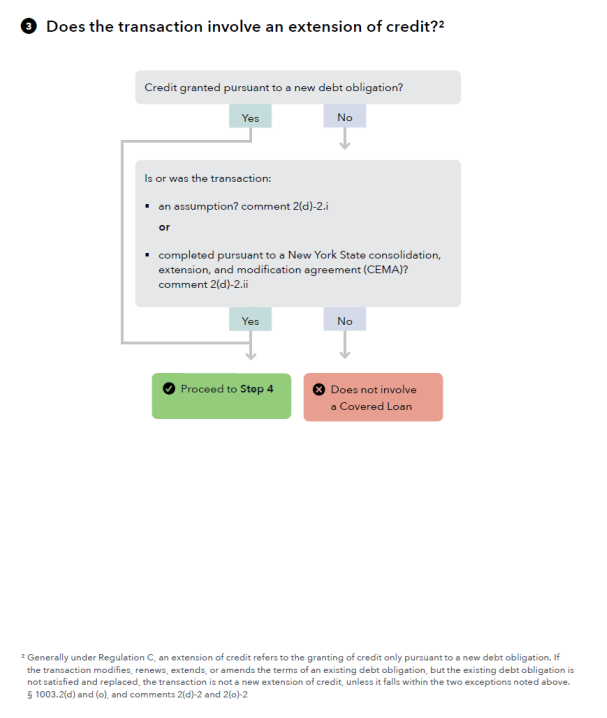
A closed-end loan or open-end line of credit is not a closed-end mortgage loan or an open-end line of credit under Regulation C unless it involves an extension of credit. Individual draws on an open-end line of credit are not separate extensions of credit. Comment 2(o)-2.
Under Regulation C,11 an “extension of credit” generally requires a new debt obligation. Comment 2(d)-2. Thus, for example, a loan modification where the existing debt obligation is not satisfied and replaced is not generally a covered loan (i.e., closed-end mortgage loan or open-end line of credit) under Regulation C. Except as described below, if a transaction modifies, renews, extends, or amends the terms of an existing debt obligation, but the existing debt obligation is not satisfied and replaced, the transaction is not a covered loan.
Regulation C provides two narrow exceptions to the requirement that an “extension of credit” involve a new debt obligation. The exceptions are designed to capture transactions that are substantially similar to new debt obligations and should be treated as such.
First, assumptions are extensions of credit under Regulation C. A loan assumption is a transaction in which a financial institution enters into a written agreement accepting a new borrower in place of an existing borrower as the obligor on an existing debt obligation. Regulation C clarifies that assumptions include successor-in-interest transactions in which an individual succeeds the prior owner as the property owner and then assumes the existing debt secured by the property. Assumptions are extensions of credit even if the new borrower merely assumes the existing debt obligation and no new debt obligation is created. Comment 2(d)-2.i.
Second, Regulation C provides that transactions completed pursuant to a New York State consolidation, extension, and modification agreement (New York CEMA) and classified as a supplemental mortgage under New York Tax Law Section 255, such that the borrower owes reduced or no mortgage recording taxes, is an extension of credit. However, the regulation also provides that certain transactions providing new funds that are consolidated into a New York CEMA are excluded from the HMDA reporting requirements. Comment 2(d)-2.ii; 12 CFR 1003.3(c)(13).
Secured by a Lien on a Dwelling
A loan is not a closed-end mortgage loan and a line of credit is not an open-end line of credit unless it is secured by a lien on a dwelling. A dwelling is a residential structure. There is no requirement that the structure be attached to real property or that it be the applicant’s or borrower’s residence. Examples of dwellings include:
- Principal residences;
- Second homes and vacation homes;
- Investment properties;
- Residential structures whether or not attached to real property;
- Detached residential structures;
- Individual condominium and cooperative units;
- Manufactured homes or other factory-built homes; and
- Multifamily residential structures or communities, such as apartment buildings, condominium complexes, cooperative buildings or housing complexes, and manufactured home communities. 12 CFR 1003.2(f); comments 2(f)-1 and -2.
A dwelling is not limited to a structure that has four or fewer units. It also includes a multifamily dwelling, which is a dwelling that includes five or more individual dwelling units. A multifamily dwelling includes a manufactured home community.
A loan related to a manufactured home community is secured by a dwelling even if it is not secured by any individual manufactured homes, but is secured only by the land that constitutes the manufactured home community. However, a loan related to a multifamily residential structure or community other than a manufactured home community is not secured by a dwelling unless it is secured by one or more individual dwelling units. For example, a loan that is secured only by the common areas of a condominium complex or only by an assignment of rents from an apartment building is not secured by a dwelling. Comment 2(f)-2. Further, a covered loan secured by five or more separate dwellings, which are not multifamily dwellings, in more than one location is not a loan secured by a multifamily dwelling. For example, assume a landlord uses a covered loan to improve five or more dwellings, each with one individual dwelling unit, located in different parts of a town, and the loan is secured by those properties. The covered loan is not secured by a multifamily dwelling as defined by § 1003.2(n). Likewise, a covered loan secured by five or more separate dwellings that are located within a multifamily dwelling, but which is not secured by the entire multifamily dwelling (e.g., an entire apartment building or housing complex), is not secured by a multifamily dwelling as defined by § 1003.2(n). For example, assume that an investor purchases 10 individual unit condominiums in a 100-unit condominium complex using a covered loan. The covered loan would not be secured by a multifamily dwelling as defined by § 1003.2(n). Comment 2(n)-3.
The following are not dwellings:
- Recreational vehicles, such as boats, campers, travel trailers, or park model recreational vehicles;
- Houseboats, floating homes, or mobile homes constructed before June 15, 1976;
- Transitory residences, such as hotels, hospitals, college dormitories, or recreational vehicle parks; and
- Structures originally designed as a dwelling but used exclusively for commercial purposes, such as a home converted to a daycare facility or professional office. Comment 2(f)-3.
A property that is used for both residential and commercial purposes, such as a building that has apartment and retail units, is a dwelling if the property’s primary use is residential. Comment 2(f)-4.
A property used for both long-term housing and to provide assisted living or supportive housing services is a dwelling. However, transitory residences used to provide such services are not dwellings. Properties used to provide medical care, such as skilled nursing, rehabilitation, or long-term medical care, are not dwellings. If a property is used for long-term housing, to provide related services (such as assisted living), and to provide medical care, the property is a dwelling if its primary use is residential. Comment 2(f)-5.
A financial institution may use any reasonable standard to determine a property’s primary use, such as square footage, income generated, or number of beds or units allocated for each use. It may select the standard on a case-by-case basis. Comments 2(f)-4 and -5.
D. Excluded Transactions
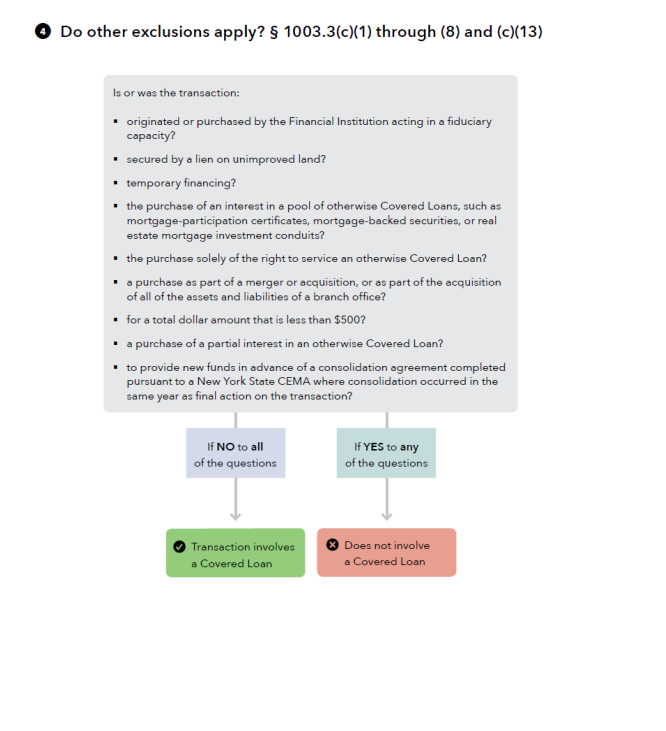
Regulation C does not apply to transactions that are specifically excluded from coverage. 12 CFR 1003.3(c). Therefore, an excluded transaction is not a covered loan. Regulation C retains and clarifies existing categories of transactions that are excluded from coverage. It also expands the existing exclusion for agricultural loans, and adds new categories of transactions that are excluded from coverage. The following are excluded transactions:
- A closed-end mortgage loan or an open-end line of credit that a financial institution originates or purchases in a fiduciary capacity, such as a closed-end mortgage loan or an open-end line of credit that a financial institution originates or purchases as a trustee. 12 CFR 1003.3(c)(1); comment 3(c)(1).
- A closed-end mortgage loan or an open-end line of credit secured by a lien on unimproved land. 12 CFR 1003.3(c)(2). Generally, a loan or line of credit must be secured by a dwelling to be a covered loan. Regulation C also lists closed-end mortgage loans and open-end lines of credit secured only by vacant or unimproved land as excluded transactions.12 However, a loan or line of credit secured by a lien on unimproved land is deemed to be secured by a dwelling (and might not be excluded) if the financial institution knows, based on information that it receives from the applicant or borrower at the time the application is received or the credit decision is made, that the proceeds of that loan or credit line will be used within two years after closing or account opening to construct a dwelling on, or to purchase a dwelling to be placed on, the land. Comment 3(c)(2)-1.
- A closed-end mortgage loan or an open-end line of credit that is temporary financing. 12 CFR 1003.3(c)(3). A transaction is excluded as temporary financing if it is designed to be replaced by separate permanent financing extended to the same borrower at a later time. The separate permanent financing may be extended by any lender (i.e., by either the lender that extended the temporary financing or another lender). In addition, a construction-only loan or line of credit is considered temporary financing and excluded under Regulation C if the loan or line of credit is extended to a person exclusively to construct a dwelling for sale. Comments 3(c)(3)-1 and -2.
- The purchase of an interest in a pool of closed-end mortgage loans or open-end lines of credit, such as mortgage-participation certificates, mortgage-backed securities, or real estate mortgage investment conduits. 12 CFR 1003.3(c)(4); comment 3(c)(4)-1.
- The purchase solely of the right to service closed-end mortgage loans or open-end lines of credit. 12 CFR 1003.3(c)(5).
- The purchase of a closed-end mortgage loan or an open-end line of credit as part of a merger or acquisition or as part of the acquisition of all of a branch office’s assets and liabilities. 12 CFR 1003.3(c)(6); comment 3(c)(6)-1. For more information on mergers and acquisitions under Regulation C, see comments 2(g)-3 and -4.
- A closed-end mortgage loan or an open-end line of credit, or an application for a closed-end mortgage loan or open-end line of credit, for which the total dollar amount is less than $500. 12 CFR 1003.3(c)(7).
- The purchase of a partial interest in a closed-end mortgage loan or an open-end line of credit. 12 CFR 1003.3(c)(8); comment 3(c)(8)-1.
- A closed-end mortgage loan or an open-end line of credit if the proceeds are used primarily for agricultural purposes or if the closed-end mortgage loan or open-end line of credit is secured by a dwelling that is located on real property that is used primarily for agricultural purposes. 12 CFR 1003.3(c)(9); comment 3(c)(9)-1. Regulation C directs financial institutions to Regulation Z’s official commentary for guidance on what is an agricultural purpose. Regulation Z’s official commentary states that agricultural purposes include planting, propagating, nurturing, harvesting, catching, storing, exhibiting, marketing, transporting, processing, or manufacturing food, beverages, flowers, trees, livestock, poultry, bees, wildlife, fish, or shellfish by a natural person engaged in farming, fishing, or growing crops, flowers, trees, livestock, poultry, bees, or wildlife. See comment 3(a)-8 in the official interpretations of Regulation Z, 12 CFR Part 1026. A financial institution may use any reasonable standard to determine the primary use of the property, and may select the standard to apply on a case-by-case basis. Comment 3(c)(9)-1.
A closed-end mortgage loan or an open-end line of credit that is or will be made primarily for business or commercial purposes, unless it is a home improvement loan, a home purchase loan, or a refinancing. 12 CFR 1003.3(c)(10). Not all transactions that are primarily for a business purpose are excluded transactions. Thus, a financial institution must collect, record, and report data for dwelling-secured, business-purpose loans and lines of credit that are home improvement loans, home purchase loans, or refinancings if no other exclusion applies. For more information on determining whether a loan or line of credit is a home purchase loan, home improvement loan, or refinancing, see 12 CFR 1003.2(f), (i), (j), and (p) and the associated commentary.
Regulation C provides that, if a closed-end mortgage loan or an open-end line of credit is deemed to be primarily for a business, commercial, or organizational purpose under Regulation Z, 12 CFR 1026.3(a) and its official commentary, then the loan or line of credit also is deemed to be primarily for a business or commercial purpose. Comment 3(c)(10)-2. For more information and examples of business-purpose or commercial-purpose transactions that are covered loans, see comments 3(c)(10)-3 and -4.
A closed-end mortgage loan if the financial institution originated fewer than 100 closed-end mortgage loans in either of the two preceding calendar years. 12 CFR 1003.3(c)(11). A financial institution is not required to collect, record, or report closed-end mortgage loans if it originated fewer than 100 of them in either of the two preceding calendar years. However, the financial institution may still be required to collect and report information regarding open-end lines of credit, depending on the number of open-end lines of credit it originates in the preceding two calendar years. Comment 3(c)(11)-1. For more information on how to determine if a financial institution “originated” a particular loan when multiple entities are involved in the transaction, see comments 4(a)-2 through -4.
A financial institution may report applications for, originations of, and purchases of closed-end mortgage loans that are excluded transactions under 12 CFR 1003.3(c)(11). However, a financial institution that chooses to report such excluded applications, originations, and purchases must report all such applications it received for closed-end mortgage loans, all closed-end mortgage loans it originates, and all closed-end mortgage loans it purchases that would otherwise be covered loans for a given calendar year. 12 CFR 1003.3(c)(11). Regulation B permits a financial institution to collect information regarding the ethnicity, race, and sex of an applicant for a closed-end mortgage loan that is an excluded transaction under 12 CFR 1003.3(c)(11), if the financial institution submits HMDA data concerning such closed-end mortgage loans and applications or if it submitted such HMDA data for any of the preceding five calendar years.13
An open-end line of credit if the number of open-end lines of credit that the financial institution originated in either of the two preceding calendar years does not meet or exceed the applicable threshold. 12 CFR 1003.3(c)(12); comment 3(c)(12)-1. A financial institution is not required to collect, record, or report open-end lines of credit if it originated fewer than 500 of them in either of the two preceding calendar years. However, the financial institution will still be required to collect and report information regarding closed-end mortgage loans if it originated at least 100 of them in each of the two preceding calendar years. Comment 3(c)(12)-1. For more information on how to determine if a financial institution “originated” a particular line of credit when multiple entities are involved in the transaction, see comments 4(a)-2 through -4.
A financial institution may report applications for, originations of, or purchases of open-end lines of credit that are excluded transactions under 12 CFR 1003.3(c)(12). However, a financial institution that chooses to report such excluded applications, originations, or purchases must report all applications for otherwise covered open-end lines of credit that it receives, all otherwise covered open-end lines of credit it originates, and all otherwise covered open-end lines of credit it purchases that would otherwise be covered loans for a given calendar year. 12 CFR 1003.3(c)(12); comment 3(c)(12)-2. Regulation B permits a financial institution to collect information regarding the ethnicity, race, and sex of an applicant for an open-end line of credit that is an excluded transaction under 12 CFR 1003.3(c)(12), if it submits HMDA data concerning such open-end lines of credit and applications or if it submitted such HMDA data for any of the preceding five calendar years.14
A transaction that provided (or, in the case of an application, proposed to provide) new funds to the borrower in advance of being consolidated in a New York CEMA classified as a supplemental mortgage under New York Tax Law Section 255. However, the transaction is excluded only if final action on the consolidation was taken in the same calendar year as the final action on the new funds transaction. 12 CFR 1003.3(c)(13). Additionally, the transaction is excluded only if, at the time that it originated the transaction providing the new funds, the financial institution intended to consolidate the loan into a New York CEMA. This exclusion does not apply to similar preliminary transactions that are consolidated pursuant to laws other than New York Tax Law Section 255. Such preliminary transactions under other laws must be reported if they are covered loans and are not covered by another exclusion. Comment 3(c)(13)-1.
New funds provided in advance of being consolidated into a New York CEMA classified as a supplemental mortgage under New York Tax Law Section 255 are reported only insofar as they form part of the total amount of the reported New York CEMA. They are not reported as a separate amount. If a New York CEMA that consolidates an excluded preliminary transaction is carried out in a transaction involving an assumption, the financial institution reports the New York CEMA and does not report the preliminary transaction separately. Comment 3(c)(13)-1.
Reportable Activity
Once a financial institution has determined whether a transaction involves a covered loan, it must determine whether it has engaged in activity that obligates it to report information about the transaction. Generally, a financial institution is required to report information for actions taken on applications (as that term is defined below) for covered loans, originations of covered loans, and purchases of covered loans. If a financial institution receives an application and that application results in the financial institution originating a covered loan, the financial institution reports the origination of the covered loan, and does not separately report the application. For more information on when to report information regarding applications and covered loans, see Applications and Originations and Purchases of Covered Loans, below. There are special rules that apply if multiple entities are involved in the transaction. These special rules are discussed in Transaction Involving Multiple Entities, below. There are also partial exemptions for which the financial institution would not be required to collect, record, or report certain data points for the transaction that qualifies for the partial exemption. These partial exemptions are discussed below in Partial Exemptions.
A. Applications
For purposes of Regulation C, an application is: (a) an oral or written request (b) for a covered loan (c) that is made in accordance with procedures the financial institution uses for the type of credit requested. 12 CFR 1003.2(b)(1).
This definition of application is similar to the Regulation B definition, except that prequalification requests are not applications under Regulation C. Interpretations that appear in the official commentary to Regulation B are generally applicable to the definition of application under Regulation C, except for those interpretations that include a prequalification request within the definition of application. Comment 2(b)-1.
Under Regulation C, a request for a preapproval may be treated differently than a request for a prequalification for certain types of loans. The determination of whether a request is a prequalification request (which is not an application) or a preapproval request (which might be an application) is based on Regulation C, not on the labels that a financial institution uses or interpretations of other regulations, such as Regulation B.
A preapproval request is an application under Regulation C if the request is:
- For a home purchase loan;
- Not secured by a multifamily dwelling;
- Not for an open-end line of credit or for a reverse mortgage; and
- Reviewed under a preapproval program (see definition of preapproval program immediately below). 12 CFR 1003.2(b)(2).
A preapproval program for purposes of Regulation C is a program in which the financial institution:
- Conducts a comprehensive analysis of the applicant’s creditworthiness (including income verification), resources, and other matters typically reviewed as part of the financial institution’s normal credit evaluation program; and then
- Issues a written commitment that: (a) is for a home purchase loan; (b) is valid for a designated period of time and up to a specified amount; and (c) is subject only to specifically permitted conditions. 12 CFR 1003.2(b)(2); comment 2(b)-3.
The written commitment issued as part of the preapproval program can be subject to only the following types of conditions:
- Conditions that require the identification of a suitable property;
- Conditions that require that no material change occur regarding the applicant’s financial condition or creditworthiness prior to closing; and
- Limited conditions that (a) are not related to the applicant’s financial condition or creditworthiness and (b) the financial institution ordinarily attaches to a traditional home mortgage application. Examples of conditions ordinarily attached to a traditional home mortgage application include requiring an acceptable title insurance binder or a certificate indicating clear termite inspection and, if the applicant plans to use the proceeds from the sale of the applicant’s present home to purchase a new home, a settlement statement showing adequate proceeds from the sale of the present home. 12 CFR 1003.2(b)(2); comment 2(b)-3.
A program that a financial institution describes as a “preapproval program” but that does not satisfy the Regulation C definition is not a preapproval program for purposes of the regulation. Comment 2(b)-3.
If a financial institution does not regularly use procedures to consider requests but instead considers requests on an ad hoc basis, the financial institution is not required to treat the ad hoc requests as having been reviewed under a preapproval program. However, a financial institution should be generally consistent in following uniform procedures for considering such ad hoc requests. Comment 2(b)-3.
Under Regulation C, a financial institution must collect, record, and report data regarding an application it receives if: (1) the application did not result in the financial institution originating a covered loan; and (2) the financial institution took action on the application or the applicant withdrew the application while the financial institution was reviewing it. For example, a financial institution reports information regarding an application that it denied, that it approved but the applicant did not accept, or that it closed for incompleteness. 12 CFR 1003.4(a), 1003.5(a) comment 4(a)-1. If the application results in the financial institution originating a covered loan, the financial institution reports the covered loan, not the application itself. For more information on reporting applications when multiple entities are involved, see Transactions Involving Multiple Entities, below.
Although requests under preapproval programs are applications, a financial institution reports data regarding a request under a preapproval program only if the preapproval request is denied or approved but not accepted. A financial institution will also report a request under a preapproval program that results in the financial institution originating a home purchase loan, but it will be reported as an originated covered loan. Comment 4(a)-1.ii.
A financial institution reports the data for an application, including a reportable preapproval request, on the HMDA Loan/Application Register (LAR) for the calendar year during which it takes action even if the financial institution received the application in a previous calendar year. Comment 4(a)-1.iv.
B. Originations and Purchases of Covered Loans
A financial institution must collect, record, and report information regarding originations and purchases of covered loans. For more information on when a financial institution reports the origination or purchase of a covered loan when multiple entities are involved, see Transactions Involving Multiple Entities, below.
A purchase includes a repurchase of a covered loan, regardless of whether the financial institution chose to repurchase the covered loan or was required to repurchase it because of a contractual obligation, and regardless of whether the repurchase occurred within the same calendar year that the covered loan was originated or in a different calendar year. Comment 4(a)-5.
A purchase does not include a temporary transfer of a covered loan to an interim funder or warehouse creditor as part of an interim funding agreement under which the financial institution that originated the covered loan is obligated to repurchase it for sale to a subsequent investor. Such funding agreements are often referred to as repurchase agreements and are sometimes used as the functional equivalents of warehouse lines of credit. Comment 4(a)-5.
C. Transactions Involving Multiple Entities
Only one financial institution reports the origination of a covered loan. If more than one institution is involved in the origination of a covered loan, the institution that makes the credit decision approving the application before loan closing or account opening is responsible for reporting the origination of the covered loan. It is not relevant whether the loan closed in the reporting financial institution’s name. If more than one institution approved an application prior to loan closing or account opening and one of those institutions purchased the covered loan after closing or account opening, the institution that purchased the covered loan after closing or account opening is responsible for reporting the origination of the covered loan. Comment 4(a)-2.
If a financial institution reports a covered loan as an origination, it reports all of the information required to be reported for the origination of a covered loan, even if the covered loan was not initially payable to the financial institution that is reporting the covered loan as an origination. Comment 4(a)-2. When reporting a covered loan as an origination, a financial institution cannot rely on exceptions or exclusions that apply to purchased covered loans, but that do not apply to originations of covered loans. See comment 4(a)-2.
In the case of an application that did not result in an origination, a financial institution reports the action it took on that application if it made a credit decision on the application or was reviewing the application when the application was withdrawn or closed for incompleteness. The financial institution is also required to report the application if the financial institution was reviewing the application when it was withdrawn or the file was closed for incompleteness. Comment 4(a)-2.ii.
If a financial institution makes a credit decision on a covered loan or application through the actions of an agent, the financial institution reports the covered loan or application. State law determines whether one party is the agent of another party. Comment 4(a)-4.
D. Partial Exemptions
The 2018 Act created partial exemptions from some of the 2015 HMDA Rule’s requirements for certain financial institutions. Only certain covered loans and applications are covered under each of the two partial exemptions. If a covered loan or application is covered by a partial exemption, the financial institution is not required to collect, record, and report specific data points. The partial exemptions were effective May 24, 2018, and apply to the collection, recording, and reporting of HMDA data on or after that date. A list of the data points covered by the partial exemptions is provided below. See A Guide to HMDA Reporting: Getting It Right! Appendix G for a list of both the partially exempt data fields and data points.
As discussed below, only a financial institution that is an insured credit union or an insured depository institution is eligible for the partial exemptions. Additionally, as explained below, in order to be eligible for the partial exemptions, an insured depository institution must not have received certain ratings in its most recent performance evaluations under the Community Reinvestment Act (CRA).15
As discussed below, each of the partial exemptions applies only to certain covered loans and applications and only if an applicable loan-volume threshold is met. An insured depository institution or insured credit union: (1) must meet the applicable loan-volume threshold for closed-end mortgage loans in order for a partial exemption to apply to its closed-end mortgage loan transactions; and (2) must meet the applicable loan-volume threshold for open-end lines of credit in order for a partial exemption to apply to its open-end line of credit transactions.
The 2018 Act created partial exemptions, not complete exclusions. Therefore, if a covered loan or application is covered by a partial exemption, the financial institution is required to collect, record, and report 22 specific data points specified in 12 CFR 1003.4(a)(1)–(38), but is exempt from collecting, recording, and reporting 26 other specific data points for that transaction. Additionally, the financial institution may voluntarily report any or all of these remaining 26 data points for a covered loan or application covered by a partial exemption. Collecting, Recording, and Reporting for Transactions Covered by a Partial Exemption, below, discusses the scope of the partial exemptions and includes tables that list both the 22 data points that are required to be collected, recorded, and reported and the 26 data points that are not required to be collected, recorded, and reported if a partial exemption applies to a covered loan or application.
Eligible Financial Institutions
In order to be eligible for a partial exemption, a financial institution must be an:
- “Insured credit union,” as defined in Section 101 of the Federal Credit Union Act, 12 U.S.C. 1752; or
- “Insured depository institution,” as defined in Section 3 of the Federal Deposit Insurance Act, 12 U.S.C. 1813.
Additionally, a financial institution that satisfies the definition of “insured depository institution” must not have received a less than satisfactory rating in its most recent CRA performance evaluations in order to be eligible for a partial exemption. More specifically, an insured depository institution must not have received either of the following:
- A rating of “needs to improve record of meeting community credit needs” during each of its two most recent examinations under Section 807(b)(2) of the CRA; or
- A rating of “substantial noncompliance in meeting community credit needs” on its most recent examination under Section 807(b)(2) of the CRA.
The CRA ratings used to determine if an insured depository institution is eligible for a partial exemption are the institution’s two most recent ratings as of December 31 of the preceding year.
A financial institution that does not satisfy either the definition of an “insured credit union” or an “insured depository institution” may not rely on either of the partial exemptions, even if it satisfies the loan-volume thresholds discussed in Loan-volume Thresholds, below. Similarly, an insured depository institution that does not satisfy the criteria regarding CRA examination history cannot rely on either of the partial exemptions.
Loan-Volume Thresholds
In order for a partial exemption to apply to an application or covered loan (including a purchased covered loan), an eligible financial institution must also meet the applicable loan-volume threshold.
A partial exemption applies to an eligible financial institution’s applications for, originations of, and purchases of closed-end mortgage loans if the institution originated fewer than 500 closed-end mortgage loans in each of the two preceding calendar years. When a financial institution determines whether it meets the loan-volume thresholds for a partial exemption, it does not count transactions excluded by 12 CFR 1003.3(c)(1) through (10) and (13).
A partial exemption applies to an eligible financial institution’s applications for, originations of, and purchases of open-end lines of credit if the institution originated fewer than 500 open-end lines of credit in each of the two preceding calendar years. However, a financial institution is not required to collect or report any information for open-end lines of credit if the institution originated fewer than 500 open-end lines of credit during either of the two preceding calendar years. This is because open-end lines of credit are excluded transactions for a financial institution that originated fewer than 500 open-end lines of credit during either of the two preceding calendar years. See the discussion regarding excluded transactions in Transactional Coverage, above.
The partial exemption for closed-end mortgage loans and the partial exemption for open-end lines of credit operate independently of one another. Thus, in a given calendar year, an eligible financial institution may be able to rely on one or both partial exemptions.
Collecting, Recording, and Reporting for Transactions Covered by a Partial Exemption
If a partial exemption applies to a covered loan or application (as discussed above), the financial institution is not required to collect, record, and report some of the data points that the 2015 HMDA Rule would otherwise require the institution to collect, record, and report for that transaction. More specifically, if a partial exemption applies to a covered loan or application, a financial institution is not required under the HMDA Rule to collect, record, or report the 26 data points listed immediately below.
Data Points Eligible Financial Institutions Need Not Collect or Report under the 2018 HMDA Rule for Transactions Covered by a Partial Exemption
- Universal Loan Identifier (ULI) (1003.4(a)(1)(i))16
- Application Channel (1003.4(a)(33))
- Loan Term (1003.4(a)(25))
- Reasons for Denial (1003.4(a)(16)17
- Property Address (1003.4(a)(9)(i))
- Manufactured Home Secured Property Type (1003.4(a)(29))
- Manufactured Home Land Property Interest (1003.4(a)(30))
- Property Value (1003.4(a)(28))
- Multifamily Affordable Units (1003.4(a)(32))
- Debt-to-Income Ratio (1003.4(a)(23))
- Combined Loan-to-Value Ratio (1003.4(a)(24))
- Credit Score (1003.4(a)(15))
- Automated Underwriting System (1003.4(a)(35))
- Interest Rate (1003.4(a)(21))
- Introductory Rate Period (1003.4(a)(26))
- Rate Spread (1003.4(a)(12))
- Non-Amortizing Features (1003.4(a)(27))
- Total Loan Costs or Total Points and Fees (1003.4(a)(17))
- Origination Charges (1003.4(a)(18))
- Discount Points (1003.4(a)(19))
- Lender Credits (1003.4(a)(20))
- Prepayment Penalty Term (1003.4(a)(22))
- Reverse Mortgage Flag (1003.4(a)(36))
- Open-End Line of Credit Flag (1003.4(a)(37))
- Business or Commercial Purpose Flag (1003.4(a)(38))
- Mortgage Loan Originator Identifier (1003.4(a)(34))
A financial institution may opt to collect, record, and report one or more of these 26 data points for a covered loan or application that is covered by a partial exemption.
Seven of these 26 data points (i.e., property address, credit score, reasons for denial, total loan costs or total points and fees, non-amortizing features, application channel, and automated underwriting system) have multiple data fields. If a financial institution opts to report a data point with multiple fields, it must report all of the data fields that make up that data point.
If a financial institution opts not to report one of the 26 data points other than the ULI, the financial institution generally reports that the covered loan or application is exempt from that data point. However, if a data point is not applicable to the particular transaction and the transaction is exempt from that data point, the financial institution may choose to report either that the data point is not applicable or that the transaction is exempt from the data point.
If a covered loan or application is covered by a partial exemption, a financial institution must collect, record, and report 22 data points for the covered loan or application. These 22 data points are set forth below.
Data Points that Must Be Collected and Reported under the 2018 HMDA Rule for Covered Loans and Applications Covered by a Partial Exemption
- Ethnicity (1003.4(a)(10)(i))
- Race (1003.4(a)(10)(i))
- Sex (1003.4(a)(10)(i))
- Age (1003.4(a)(10)(ii))
- Income (1003.4(a)(10)(iii))
- Legal Entity Identifier (LEI) (1003.5(a)(3))
- Application Date (1003.4(a)(1)(ii)
- Preapproval (1003.4(a)(4))
- Loan Type (1003.4(a)(2))
- Loan Purpose (1003.4(a)(3))
- Loan Amount (1003.4(a)(7))
- Action Taken (1003.4(a)(8)(i))
- Action Taken Date (1003.4(a)(8)(ii))
- State (1003.4(a)(9)(ii)(A))
- County (1003.4(a)(9)(ii)(B))
- Census Tract (1003.4(a)(9)(ii)(C))
- Construction Method (1003.4(a)(5))
- Occupancy Type (1003.4(a)(6)
- Lien Status (1003.4(a)(14))
- Number of Units (1003.4(a)(31))
- HOEPA Status (1003.4(a)(13))
- Type of Purchaser (1003.4(a)(11))
Because the partial exemptions do not affect these 22 data points, financial institutions must continue to collect, record, and report these 22 data points for covered loans and applications in the manner specified in the 2015 HMDA Rule, as amended and clarified by the 2017 HMDA Rule. As discussed above, a financial institution is not required to collect or report any information for open-end lines of credit if the institution originated fewer than 500 open-end lines of credit during either of the two preceding calendar years. See the discussion regarding excluded transactions in Transactional Coverage, above.
For more information on reporting data points if a covered loan or application is covered by a partial exemption, see the following Compilation of Loan Data section of these procedures and the Filing Instructions Guide that incorporates the 2018 HMDA Rule available at http://www.consumerfinance.gov/data-research/hmda/for-filers.
Compilation of Loan Data
Attachment A is a summary of the data points required to be collected, recorded, and reported beginning in 2018 and provides information on where to find specific guidance in the regulation and commentary on what should be included for each data point.18 Additional information on the data fields and codes used in preparing the HMDA LAR is provided in the HMDA Filing Instructions Guide (FIG) available at https://ffiec.cfpb.gov/.19
Reporting
A. Recording
Regulation C requires a financial institution to record the data about a covered loan or application on a HMDA LAR within 30 calendar days after the end of the calendar quarter in which the financial institution takes final action on the covered loan or application. 12 CFR 1003.4(f). A financial institution is not required to record all of its HMDA data for a quarter on a single HMDA LAR. Rather, a financial institution may record data on a single HMDA LAR or may record data on one or more HMDA LARs for different branches or different loan types (such as home purchase loans or home improvement loans or loans on multifamily dwellings). Comment 4(f)-1.
Other State or Federal regulations may require a financial institution to record its data on a HMDA LAR more frequently. Comment 4(f)-2.
Financial institutions may maintain their quarterly records in electronic or any other format, provided they can make the information available to their regulatory agencies in a timely manner upon request. Comment 4(f)-3.
B. Reporting
In addition to the required data discussed in 12 CFR 1003.4(a) and (b), effective January 1, 2019, a financial institution must include the following when it submits its HMDA data:
- Its name;
- The calendar year and, effective January 1, 2020, if applicable, the calendar quarter to which the data relate (see 12 CFR 1003.5(a)(1)(ii)20 for information on quarterly reporting);
- The name and contact information for a person who can be contacted with questions about the submission;
- The financial institution’s appropriate Federal agency;
- The total number of entries in the submission;
- The financial institution’s Federal Taxpayer Identification Number (TIN); and
- The financial institution’s Legal Entity Identifier (LEI). 12 CFR 1003.5(a)(3).
If the appropriate Federal agency for a financial institution changes, the financial institution must identify its new appropriate Federal agency in its annual submission for the year of the change. Comment 5(a)-2. For example, if a financial institution’s appropriate Federal agency changes in February 2018, it must identify its new appropriate Federal agency beginning with its annual submission of 2018 data by March 1, 2019. Comment 5(a)-5. For a financial institution required to comply with quarterly reporting requirements (see 12 CFR 1003.5(a)(1)(ii)), the financial institution also must identify its new appropriate Federal agency in its quarterly submission beginning with its submission for the quarter of the change, unless the change occurs during the fourth quarter (in which case, the financial institution would identify the new appropriate Federal agency in its annual submission). For example, if the appropriate Federal agency for a financial institution changes during February 2020, the financial institution must identify its new appropriate Federal agency beginning with its quarterly submission for the first quarter of 2020. Comment 5(a)-2.
If a financial institution obtains a new TIN, it must provide the new TIN in its subsequent data submissions. For example, if two financial institutions that previously reported HMDA data merge and the surviving financial institution retained its LEI but obtained a new TIN, the surviving financial institution reports the new TIN beginning with its next HMDA data submission. Comment 5(a)-5.
A financial institution that is a subsidiary of a bank or savings association must complete its own HMDA LAR and submit it, directly or through its parent, to the appropriate Federal agency for the subsidiary’s parent. 12 CFR 1003.5(a)(2). A financial institution is a subsidiary of a bank or savings association (for purposes of reporting HMDA data to the same agency as the parent) if the bank or savings association holds or controls an ownership interest in the financial institution that is greater than 50 percent. Comment 5(a)-3.
C. Annual Reporting
Regulation C maintains the annual reporting requirement, but requires financial institutions to submit data electronically in accordance with the procedures published by the Bureau. 12 CFR 1003.5(a)(5). These procedures do not provide detailed information about the HMDA submission process or file, data, and edit specifications. Information about those topics can be found on the FFIEC’s web pages available at https://ffiec.cfpb.gov and https://www.ffiec.gov/hmda/.
Under Regulation C, a financial institution must submit its annual HMDA LAR in electronic format to its appropriate Federal supervisory agency by March 1 of the year following the calendar year for which the data are collected. 12 CFR 1003.5(a)(1)(i). An individual who is an authorized representative of the financial institution and who has knowledge regarding the submitted data must certify its accuracy and completeness. 12 CFR 1003.5(a)(1)(i).
A financial institution must retain a copy of its submitted annual HMDA LAR for at least three years. 12 CFR 1003.5(a)(1)(i). Financial institutions may retain their annual HMDA LARs in either paper or electronic form. Comment 5(a)-4.
For more information on reporting under Regulation C or on the electronic submission of data, please see https://ffiec.cfpb.gov.
D. Quarterly Reporting
The HMDA Rule requires some financial institutions to report data on a quarterly basis as well as on an annual basis. The quarterly reporting requirement is effective January 1, 2020. It applies to a financial institution that reported at least 60,000 originated covered loans and applications (combined) for the preceding calendar year. The financial institution does not count purchased covered loans when determining whether the quarterly reporting requirement applies. If quarterly reporting is required, the financial institution must report all data required to be recorded for the calendar quarter within 60 calendar days after the end of the calendar quarter. The quarterly reporting requirement does not apply, however, to the fourth quarter of the year. A financial institution subject to the quarterly reporting requirement reports its fourth quarter data as part of its annual submission. In its annual submission, a quarterly reporter will resubmit the data previously submitted for the first three calendar quarters of the year, including any corrections to the data, as well as its fourth quarter data. 12 CFR 1003.5(a)(ii).
Disclosure of Data
A. Disclosure Statement
Under Regulation C, the FFIEC shall provide a notice to the financial institution that the financial institution’s disclosure statement (aggregated data derived from loan-level data submitted for the prior calendar year) is available. 12 CFR 1003.5(b)(1). No later than three business days (any calendar day other than a Saturday, Sunday, or legal public holiday) after receiving notice from the FFIEC, the financial institution must make available to the public, upon request, a written notice that clearly conveys that the financial institution’s disclosure statement may be obtained on the Bureau’s website at http://www.consumerfinance.gov/hmda. 12 CFR 1003.5(b)(2); comment 5(b)-1. A financial institution’s disclosure statement may also be obtained from https://ffiec.cfpb.gov. A financial institution may, but is not required to, use the sample notice in to satisfy Regulation C’s disclosure statement requirement. The notice may be made available in paper or electronic form. Comment 5(b)-2.
A financial institution must make the notice available to the public for a period of five years. 12 CFR 1003.5(d)(1).
At its discretion, a financial institution may also provide its disclosure statement and impose a reasonable fee for costs incurred reproducing or providing the statement. 12 CFR 1003.5(d)(2). Even if it provides the disclosure statement, a financial institution must comply with the notice requirement.
B. Modified HMDA LAR21
Upon request from a member of the public, a financial institution must provide a written notice regarding the availability of its modified HMDA LAR (the financial institution’s HMDA LAR, as modified by the Bureau to protect applicant and borrower privacy). 12 CFR 1003.5(c). The written notice must clearly convey that the financial institution’s HMDA LAR, as modified by the Bureau to protect borrower and applicant privacy, may be obtained on the Bureau’s website at http://www.consumerfinance.gov/hmda. A financial institution’s HMDA LAR is also available at https://ffiec.cfpb.gov.
A financial institution may, but is not required to, use the sample notice in comment 5(c)-2 to the regulation to satisfy Regulation C’s modified HMDA LAR requirement. Comment 5(c)-2. A financial institution may, but is not required to, use the same notice for purposes of this disclosure requirement and the disclosure statement requirement discussed in the Disclosure Statement section above. The notice may be made available in paper or electronic form. Comment 5(c)-1.
The notice must be made available in the calendar year following the calendar year for which the financial institution collected data. 12 CFR 1003.5(d)(1). The notice must be made available for three years. For example, for data that it was required to collect in 2018, a financial institution must make available a notice through calendar year 2021 that its modified HMDA 2018 LAR is available.
At its discretion, a financial institution may also provide its HMDA LAR, as modified by the Bureau, and impose a reasonable fee for any costs incurred to reproduce or provide the data. 12 CFR 1003.5(d)(2). Even if it decides to provide the modified HMDA LAR, a financial institution must comply with the notice requirement.
C. Posted Notices
A financial institution must post, in the lobby of its home office and each branch office physically located in an MSA or Metropolitan Division (MD), a general notice about the availability of its HMDA data on the Bureau’s website. 12 CFR 1003.5(e). A financial institution may, but is not required to, use the sample notice in comment 5(e)-1 to the regulation to satisfy this requirement. In any case, the notice must clearly convey that the financial institution’s HMDA data are available on the Bureau’s website at http://www.consumerfinance.gov/hmda. Comment 5(e)-1.
D. Aggregated Data
The FFIEC will use the annual data submitted pursuant to Regulation C to make available aggregated data for each MSA and MD, showing lending patterns by property location, age of housing stock, and income level, sex, ethnicity, and race. 12 CFR 1003.5(f).
Administrative Enforcement
A violation of Regulation C is subject to administrative sanctions, including civil money penalties. Compliance can be enforced by the Bureau, the U.S. Department of Housing and Urban Development, the FDIC, the FRB, the National Credit Union Administration, or the Office of the Comptroller of Currency.
An error in compiling or recording data for a covered loan or application is not a violation of HMDA or Regulation C if the error was unintentional and occurred despite maintenance of procedures reasonably adapted to avoid such errors. 12 CFR 1003.6(b)(1). However, a financial institution that obtains the property-location information for applications and covered loans from third parties is responsible for ensuring that the information reported is correct. Comment 6(b)-1. An incorrect entry for a census tract number is deemed a bona fide error and is not a violation if the financial institution maintains procedures reasonably adapted to avoid such an error. 12 CFR 1003.6(b)(2).
If an institution makes a good-faith effort to record all data concerning covered transactions fully and accurately within thirty calendar days after the end of each calendar quarter, and some data are nevertheless inaccurate or incomplete, the error or omission is not a violation of HMDA or Regulation C, provided that the institution corrects or completes the information prior to submitting the loan/application register to its regulatory agencies. 12 CFR 1003.6(b)(3).
WHO MUST REPORT: HMDA INSTITUTIONAL COVERAGE
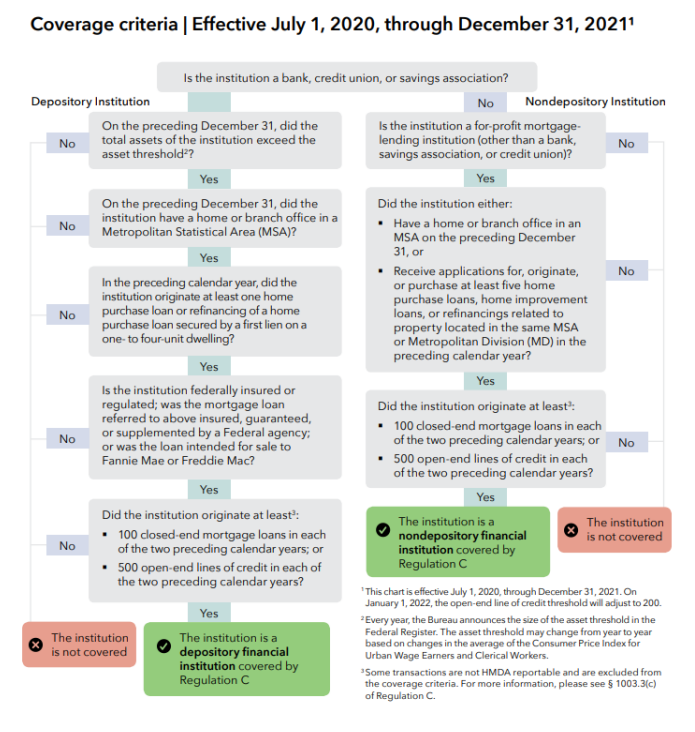
HMDA TRANSACTIONAL COVERAGE
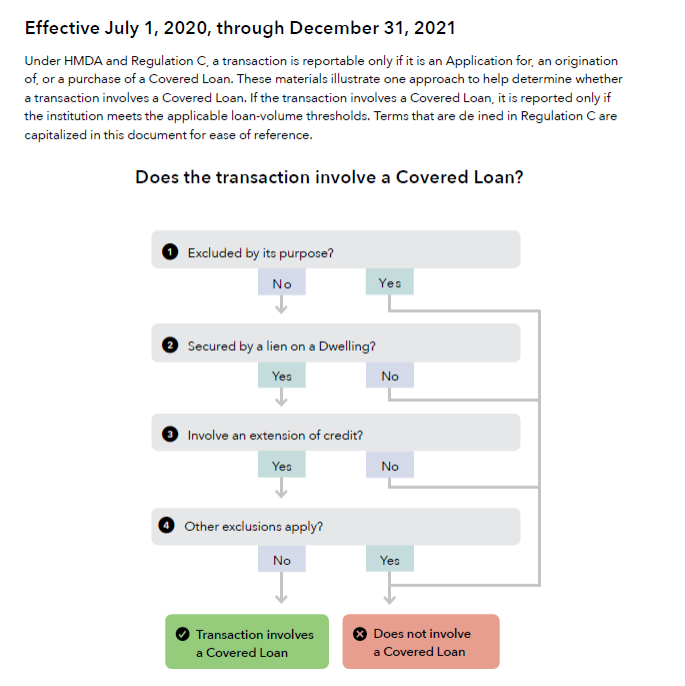
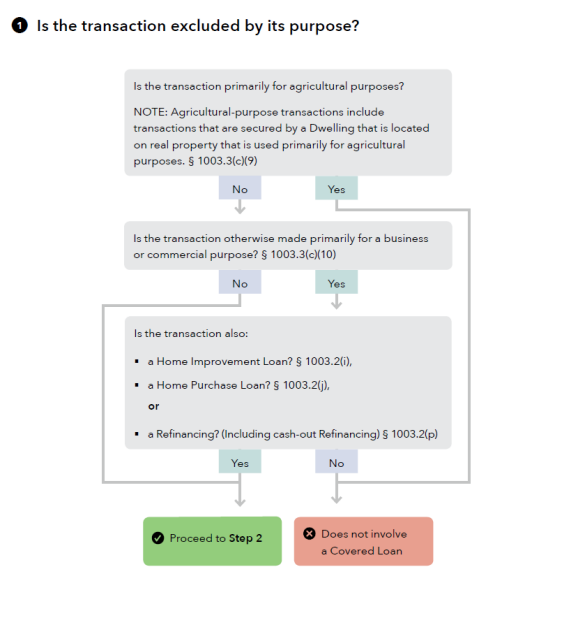
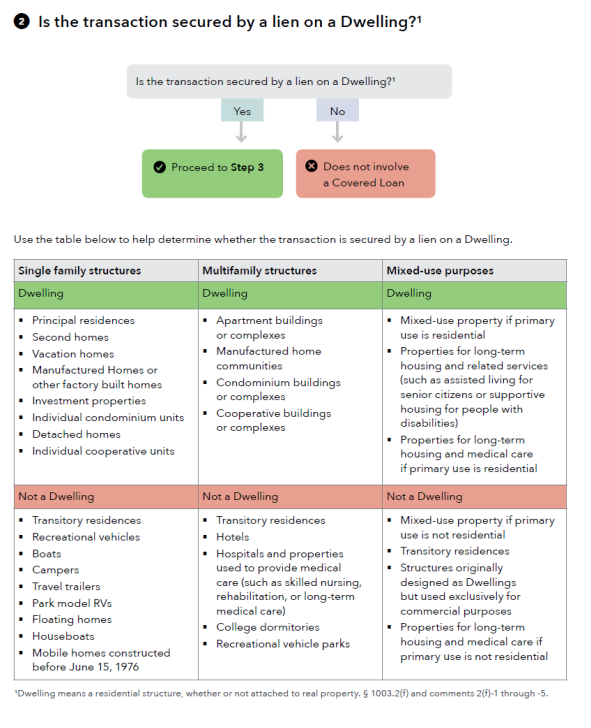
Examination Objectives
- To determine the accuracy and timeliness of the financial institution’s HMDA LAR.
- To determine the financial institution’s compliance with disclosure requirements.
Examination Procedures22
Initial Procedures
A. Institutional Coverage
Determine whether an institution is subject to Regulation C because it meets the definition of financial institution. 12 CFR 1003.2(g).
Depository Financial Institutions
A depository financial institution is subject to Regulation C if the requirements of 12 CFR 1003.2(g)(1) are met. If the institution is a bank, savings association, or credit union, determine whether it meets the Asset-Size Threshold Test, the Location Test, the Loan Activity Test, the Federally Related Test, and the Loan-Volume Threshold Test, which are listed below. If all five tests are satisfied, then the financial institution is required to report mortgage data in accordance with Regulation C.
- Asset-Size Threshold Test. Determine whether, on the preceding December 31, the institution had assets in excess of the asset-size threshold published annually in the Federal Register, as included in the Official Interpretations, 12 CFR Part 1003, comment 2(g)-2. 12 CFR 1003.2(g)(1)(i).
- Location Test. Determine whether, on the preceding December 31, the institution had a home or branch office located in an MSA. 12 CFR 1003.2(g)(1)(ii).
- Loan Activity Test. Determine whether the institution originated at least one home purchase loan or refinancing of a home purchase loan secured by a first lien on a one-to-four-unit dwelling during the preceding calendar year. 12 CFR 1003.2(g)(1)(iii).
- Federally Related Test. Determine whether the institution meets one of following criteria:
- The institution is federally insured or federally regulated.(12 CFR 1003.2(g)(1)(iv)(A)); or
- The institution originated at least one home purchase loan or refinancing of a home purchase loan that was secured by a first lien on a one-to-four-unit dwelling and also (i) was insured, guaranteed, or supplemented by a Federal agency or (ii) was intended for sale to Fannie Mae or Freddie Mac (12 CFR 1003.2(g)(1)(iv)(B)).
- Loan-Volume Threshold Test. Determine whether the institution originated at least100 closed-end mortgage loans in each of the two preceding calendar years, or originated at least 500 open-end lines of credit in each of the two preceding calendar years. Determine whether transactions are appropriately excluded from coverage by Regulation C according to criteria in 12 CFR 1003.3(c)(1)–(13). The list of excluded transactions and definitions for closed-end mortgage loans and open-end lines of credit are described below in the Transactional Coverage section of these procedures.
Nondepository Financial Institutions
A nondepository financial institution is subject to Regulation C if the requirements of 12 CFR 1003.2(g)(2) are met. If the institution is a nondepository financial institution other than a bank, savings association, or credit union, determine whether it meets the Location Test and the Loan-Volume Threshold Test described below. If both tests are satisfied, then the financial institution is required to report mortgage data in accordance with Regulation C.
- Location Test. Determine whether the institution had a home or branch office in an MSA on the preceding December 31. 12 CFR 1003.2(g)(2)(i).
- Loan-Volume Threshold Test. Determine whether the institution originated at least 100 closed-end mortgage loans in each of the two preceding calendar years, or originated at least 500 open-end lines of credit in each of the two preceding calendar years. Determine whether any transactions are appropriately excluded from coverage by Regulation C according to criteria in 12 CFR 1003.3(c)(1)-(13).
The list of excluded transactions and definitions for closed-end mortgage loans and open-end lines of credit are described below in the TRANSACTIONAL COVERAGE section.
Merger or Acquisition Activity
If recent merger or acquisition activity has occurred, determine whether the surviving or newly formed institution meets the definition of financial institution in 12 CFR 1003.2(g). After a merger or acquisition, the surviving or newly formed institution is a financial institution according to 12 CFR 1003.2(g) if it, considering the combined assets, location, and lending activity of the surviving or newly formed institution and the merged or acquired institutions or acquired branches, satisfies the criteria included in 12 CFR 1003.2(g). For examples of institutional coverage by Regulation C after merger or acquisition activity, please see Official Interpretations, Supplement I to 12 CFR Part 1003, comment 2(g)-3.
B. Transactional Coverage
Determine whether a transaction is subject to Regulation C because it:
- meets the definition of a covered loan as defined in 12 CFR 1003.2(e), and
- is not an excluded transaction as defined in 12 CFR 1003.3(c)(1)–(13).
Covered Loans
Institutions that meet the definition of financial institution according to 12 CFR 1003.2(g) must report data on transactions that meet the definition of a covered loan in 12 CFR 1003.2(e). Types of transactions enumerated in 12 CFR 1003.3(c)(1)–(13) are explicitly excluded from Regulation C reporting requirements.
- Covered Loan. Determine whether the transaction meets the definition of covered loan according to 12 CFR 1003.2(e) and should be reported under Regulation C. A covered loan is a closed-end mortgage loan or an open-end line of credit that is not a transaction specifically excluded from the reporting requirements of the regulation.
- Determine whether the transaction is a closed-end mortgage loan as defined in 12 CFR 1003.2(d). A closed-end mortgage loan is:
- An extension of credit;
- Secured by a lien on a dwelling; and
- Is not an open-end line of credit, as defined by 12 CFR 1003.2(o).
- Determine whether the transaction is an open-end line of credit as defined in 12 CFR 1003.2(o). An open-end line of credit is:
- An extension of credit;
- Secured by a lien on a dwelling; and
- Is an open-end credit plan as defined in Regulation Z, 12 CFR 1026.2(a)(20), but without regard to whether the credit is consumer credit, as defined in 12 CFR 1026.2(a)(12), is extended by a creditor as defined in 12 CFR 1026.2(a)(17), or is extended to a consumer as defined in 12 CFR 1026.2(a)(11).
- Determine whether the transaction is a closed-end mortgage loan as defined in 12 CFR 1003.2(d). A closed-end mortgage loan is:
Note: Further, a covered loan secured by five or more separate dwellings, which are not multifamily dwellings, in more than one location is not a loan secured by a multifamily dwelling. For example, assume a landlord uses a covered loan to improve five or more dwellings, each with one individual dwelling unit, located in different parts of a town, and the loan is secured by those properties. The covered loan is not secured by a multifamily dwelling as defined by § 1003.2(n). Likewise, a covered loan secured by five or more separate dwellings that are located within a multifamily dwelling, but which is not secured by the entire multifamily dwelling (e.g., an entire apartment building or housing complex), is not secured by a multifamily dwelling as defined by § 1003.2(n). For example, assume that an investor purchases 10 individual unit condominiums in a 100-unit condominium complex using a covered loan. The covered loan would not be secured by a multifamily dwelling as defined by § 1003.2(n). Comment 2(n)-3.
- Excluded Transactions. Determine whether the type of transaction is listed as an excluded transaction in 12 CFR 1003.3(c). The following transactions are not required to be reported under Regulation C:
- A closed-end mortgage loan or open-end line of credit originated or purchased by a financial institution acting in a fiduciary capacity (12 CFR 1003.3(c)(1));
- A closed-end mortgage loan or open-end line of credit secured by a lien on unimproved land (12 CFR 1003.3(c)(2));
- Temporary financing (12 CFR 1003.3(c)(3));
- The purchase of an interest in a pool of closed-end mortgage loans or open-end lines of credit (12 CFR 1003.3(c)(4));
- The purchase solely of the right to service closed-end mortgage loans or open-end lines of credit (12 CFR 1003.3(c)(5));
- The purchase of closed-end mortgage loans or open-end lines of credit as part of a merger or acquisition, or as part of the acquisition of all of the assets and liabilities of a branch office as defined in 12 CFR 1003.2(c) (12 CFR 1003.3(c)(6));
- A closed-end mortgage loan or open-end line of credit, or an application for a closed-end mortgage loan or open-end line of credit, for which the total dollar amount is less than $500 (12 CFR 1003.3(c)(7));
- The purchase of a partial interest in a closed-end mortgage loan or open-end line of credit (12 CFR 1003.3(c)(8));
- A closed-end mortgage loan or open-end line of credit that is or will be used primarily for agricultural purposes (12 CFR 1003.3(c)(9));
- A closed-end mortgage loan or open-end line of credit that is or will be made primarily for a business or commercial purpose, unless the closed-end mortgage loan or open-end line of credit is a home improvement loan under 12 CFR 1003.2(i), a home purchase loan under 12 CFR 1003.2(j), or a refinancing under 12 CFR 1003.2(p) (12 CFR 1003.3(c)(10));
- Exclusions based on a financial institution’s loan-volume:
- An institution that originated fewer than 100 closed-end mortgage loans in either of the two proceeding calendar years is not required to report closed-end mortgage loans (12 CFR 1003.3(c)(11)).
- An institution that originated fewer than 500 open-end lines of credit in either of the two preceding calendar years is not required to report open-end lines of credit, (12 CFR 1003.3(c)(12)).
- A transaction that provided or, in the case of an application, proposed to provide new funds to the applicant or borrower in advance of being consolidated in a New York State consolidation, extension, and modification agreement (as before, New York CEMA) classified as a supplemental mortgage under New York Tax Law section 255, where final action was taken on the consolidation and the new funds transaction in the same calendar year. (12 CFR 1003.3(c)(13)).
Disclosure and Reporting – 12 CFR 1003.5
- Determine whether the financial institution satisfies requirements related to disclosure and reporting:
- Reporting to agency. Determine whether the financial institution submits its HMDA LAR to the appropriate Federal agency no later than March 1 following the calendar year for which the data are compiled. 12 CFR 1003.5(a)(1)(i).
- HMDA LAR retention. Determine whether the financial institution retained a copy of its submitted annual HMDA LAR for at least three years. 12 CFR 1003.5(a)(1)(i).
- Disclosure statement. Determine whether no later than three business days after the financial institution receives notice from the FFIEC that the financial institution’s disclosure statement is available the financial institution makes available to the public upon request at its home office, and each branch office physically located in each MSA and each MD, a written notice that clearly conveys that the financial institution’s disclosure statement may be obtained on the Bureau’s website at consumerfinance.gov/hmda. 12 CFR 1003.5(b)(2). A financial institution’s disclosure statement may also be obtained from https://ffiec.cfpb.gov.
- Modified HMDA LAR. Determine whether the financial institution makes available to the public upon request at its home office, and each branch office physically located in each MSA and each MD, a written notice that clearly conveys that the financial institution’s HMDA LAR, as modified by the Bureau to protect applicant and borrower privacy, may be obtained on the Bureau’s website at consumerfinance.gov/hmda. 12 CFR 1003.5(c). A financial institution’s modified HMDA LAR may also be obtained from https://ffiec.cfpb.gov.
- Posted notice of availability of data. Determine whether the financial institution posts a general notice about the availability of its HMDA data in the lobby of its home office and of each branch office located in each MSA and each MD. This notice must clearly convey that the financial institution’s HMDA data is available on the Bureau’s website at consumerfinance.gov/hmda. 12 CFR 1003.5(e). A financial institution’s HMDA data is also available at https://ffiec.cfpb.gov.
If the financial institution is a bank or savings association and has a subsidiary covered by HMDA, determine whether the subsidiary completed a separate HMDA LAR and either submitted it directly or through its parent to the appropriate Federal agency for the parent. For this purpose, a financial institution is a subsidiary of a bank or savings association if the bank or savings association holds or controls an ownership interest of greater than 50 percent in the financial institution. (12 CFR 1003.5(a)(2), comment 5(a)-6).
FFIEC HMDA Examiner Transaction Testing Guidelines
- To conduct HMDA transaction testing, examiners select a random sample of entries from the financial institution’s HMDA LAR (Total Sample) and ask the financial institution to provide the loan or application files (loan files) that correspond to the HMDA LAR sample entries. The size of the Total Sample will depend on the size of the financial institution’s HMDA LAR, as shown in column A of the “HMDA Transaction Testing Sample Sizes and Thresholds” table (HMDA table) below.
- If a financial institution’s HMDA data are collected through multiple data collection and reporting systems, examiners may test a single sample from the financial institution’s entire HMDA LAR, test separate samples from each system, or test samples from selected systems chosen based on risk. If examiners do not take a single sample from the entire HMDA LAR, they should document in their work papers from which system(s) they chose the sample(s) and why.
- Once examiners receive the loan files from the financial institution, they should verify the accuracy of the data in the entries in the HMDA LAR sample(s) against the corresponding loan files. Examiners should document in their work papers any differences between the data in the HMDA LAR and information in files, and determine whether the differences may be explained by any additional information that the financial institution may provide. Differences that are not adequately explained should be identified as errors.
- All data fields within the sample may be reviewed, or the supervisory agency may prioritize designated fields for review.
- HMDA transaction testing can be divided into two stages. Both stages test for errors only in individual data fields that are selected for review as provided above in paragraph 4. In Stage 1, examiners review only a subset of the sample (Initial Sample). The size of the Initial Sample will depend on the size of the financial institution’s HMDA LAR, as shown in column B of the HMDA table. If the number of errors identified in the Initial Sample falls below the Initial Sample Threshold in column C of the HMDA table for each and every data field reviewed, no further sample review is required and the examiners may conclude the transaction testing. If the number of errors in any data field reviewed equals or exceeds the Initial Sample Threshold in column C of the HMDA table, examiners should proceed to Stage 2 and review the remainder of the Total Sample. In Stage 2, examiners must review all data fields that had one or more errors in the Initial Sample and may review any or all Initial Sample data fields reviewed and found to have no errors in Stage 1.
- If, after reviewing the remainder of the Total Sample in Stage 2, the total number of errors in any data field equals or exceeds the Resubmission Threshold in column D of the HMDA table, examiners should direct the financial institution to correct any such data field in its full HMDA LAR and resubmit its HMDA LAR with the corrected data field(s).
- A financial institution may also be directed to correct one or more individual data fields and resubmit its HMDA LAR, even if errors in that field or fields do not meet the Resubmission Threshold in column D of the HMDA table, if examiners have a reasonable basis to believe that errors in that field or fields will likely make analysis of the HMDA data unreliable. To illustrate, assume examiners discover that a financial institution has incorrectly coded withdrawn applications as denials to such an extent that it likely prevents reliable analysis of underwriting disparities in a fair lending examination. Examiners may direct a financial institution to correct the Action Taken data field and resubmit the HMDA LAR even if the number of Action Taken errors found in the Total Sample does not equal or exceed the Resubmission Threshold in column D of the HMDA table.
- A financial institution may be directed to resubmit its HMDA LAR in order to include reportable applications or loans that examiners determined were previously omitted from the HMDA LAR.
Tolerances
- For the sole purpose of determining whether the number of errors equals or exceeds the Initial Sample Threshold in column C or the Resubmission Threshold in column D of the HMDA table, examiners should not count the following differences between data in the HMDA LAR and in the loan files as errors:
- Three calendar days or less in the date the application was received or the date shown on the application form reported pursuant to 12 CFR 1003.4(a)(1)(ii);
- One thousand dollars or less in the amount of the covered loan or the amount applied for, as applicable, reported pursuant to 12 CFR 1003.4(a)(7);
- Three calendar days or less in the date of the action taken by the financial institution reported pursuant to 12 CFR 1003.4(a)(8)(ii), provided that such differences do not result in reporting data for the wrong calendar year; and
- Rounding errors in reporting the dollar amount, rounded to the nearest thousand, of the gross annual income relied on in making the credit decision or, if a credit decision was not made, the gross annual income relied on in processing the application, reported pursuant to 12 CFR 1003.4(a)(10)(iii).
To illustrate, if a loan file indicates June 4 as the application date, a HMDA LAR application date of June 1 or June 7 would not be counted as an error because it is within three calendar days of June 4, but a HMDA LAR application date of May 31 or June 8 would be counted as an error because it is more than three calendar days from June 4.
Ethnicity or Race Data Errors
- For purposes of these guidelines, the term “data field” generally refers to individual HMDA Filing Instructions Guide (FIG) fields, each identified by a distinct Data Field Number and Data Field Name. With respect to information on the ethnicity or race of an applicant or borrower, or co-applicant or co-borrower, however, a data field consists of a group of FIG fields as follows:
- The Ethnicity of Applicant or Borrower data field group: comprised of six FIG fields with information on an applicant’s or borrower’s ethnicity (FIG Data Field Numbers 19-24);
- The Ethnicity of Co-Applicant or Co-Borrower data field group: comprised of six FIG fields with information on a co-applicant’s or co-borrower’s ethnicity (FIG Data Field Numbers 25-30);
- The Race of Applicant or Borrower data field group: comprised of eight FIG fields with information on an applicant’s or borrower’s race (FIG Data Field Numbers 33-40); and
- The Race of Co-Applicant or Co-Borrower data field group: comprised of eight FIG fields with information on a co-applicant’s or co-borrower’s race (FIG Data Field Numbers 41-48).23
To illustrate, for an applicant who indicates “Hispanic or Latino” and “Mexican” in response to the question of ethnicity, a financial institution reports the information in two FIG fields, for example, Ethnicity of Applicant or Borrower: 1 (1: Hispanic or Latino) and Ethnicity of Applicant or Borrower: 2 (11: Mexican). If one or more of the six Ethnicity of Applicant or Borrower FIG fields have errors, they would count as one (and only one) error for that data field group. If the Ethnicity of Applicant or Borrower data field group has errors in the Total Sample that meet or exceed the Resubmission Threshold in column D of the HMDA table, examiners should direct the financial institution to correct the six Ethnicity of Applicant or Borrower FIG fields and resubmit its HMDA LAR with those FIG fields corrected. See example 4 in the HMDA Transaction Testing Sample Sizes and Thresholds section below.24
Prospective Changes
- Examiners may direct the financial institution to make any appropriate changes in its policies, procedures, audit processes, or other aspects of its compliance management system needed to prevent the reoccurrence of errors identified within the sample that are—absent such changes—capable of repetition, even if the number of errors does not equal or exceed either the Initial Sample Threshold in column C or the Resubmission Threshold in column D of the HMDA table, or even if the errors fall within the tolerances provided in paragraph 9.
HMDA Transaction Testing Sample Sizes and Thresholds
| HMDA LAR count | A Total | B Initial Sample size | C Initial Sample Threshold | D Resubmission Threshold | |
| # | % | ||||
| 25–50 | 30* | 15 | 2 | 3 | 10.0* |
| 51–100 | 30 | 20 | 2 | 3 | 10.0 |
| 101–130 | 47 | 29 | 2 | 3 | 6.4 |
| 131–190 | 56 | 29 | 2 | 3 | 5.4 |
| 191–500 | 59 | 30 | 2 | 3 | 5.1 |
| 501–100,000 | 79 | 35 | 2 | 4 | 5.1 |
| 100,001+ | 159 | 61 | 2 | 4 | 2.5 |
*For financial institutions with fewer than 30 HMDA LAR lines, the full sample size is the financial institution’s total number of HMDA LAR lines. The Resubmission Threshold number remains at 3. Accordingly, the Resubmission Threshold percentage will be higher for financial institutions with fewer than 30 HMDA LAR lines.
Examples
- Financial Institution A’s HMDA LAR contains 35 entries. Examiners select a Total Sample of 30 loans as shown in column A of the HMDA table.
- Examiners test the Initial Sample of 15 as shown in column B of the HMDA table and find two errors in the Action Taken data field, which equals the Initial Sample Threshold in column C of the HMDA table.
- Accordingly, the examiners proceed to review the remaining 15 entries in the Total Sample and find one additional error in the Action Taken data field for a total of three errors in that field, which equals the Resubmission Threshold in column D of the HMDA table. In the review of the remaining entries in the Total Sample, examiners also find two errors in the Rate Spread data field, which is below the Resubmission Threshold in column D of the HMDA table.
- Therefore, Financial Institution A is directed to correct the Action Taken data field and resubmit its HMDA LAR with that field corrected.
- Financial Institution B’s HMDA LAR contains 125 entries. Examiners select a Total Sample of 47 loans as shown in column A of the HMDA table.
- Examiners test the Initial Sample of 29 loans as shown in column B of the HMDA table and find one error in the Action Taken data field, which is less than the Initial Sample Threshold in column C of the HMDA table; one error in the Loan Type data field, which is less than the Initial Sample Threshold; and no other errors.
- Therefore, examiners end the HMDA transaction testing for Financial Institution B and do not proceed to Stage 2 testing of the 18 remaining entries in the Total Sample because no Stage 1 errors in any single data field equaled or exceeded the Initial Sample Threshold.
- Financial Institution C’s HMDA LAR contains 500,000 entries. Examiners select a Total Sample of 159 loans as shown in column A of the HMDA table.
- Examiners test the Initial Sample of 61 loans as shown in column B of the HMDA table and find two errors in the Action Taken data field, which equals the Initial Sample Threshold in column C of the HMDA table; and five errors in the Loan Amount data field, which exceeds the Initial Sample Threshold in column C of the HMDA table.
- Accordingly, examiners proceed to test the remaining 98 entries in the Total Sample and find two additional errors in the Action Taken data field, for a total of four errors in that field, which equals the Resubmission Threshold in column D of the HMDA table; five additional errors in the Loan Amount data field, for a total of ten errors in that field, which exceeds the Resubmission Threshold in column D of the HMDA table; and four errors in the Census Tract data field, which equals the Resubmission Threshold in column D of the HMDA table.
- Therefore, Financial Institution C is directed to correct the Action Taken data field, the Loan Amount data field, and the Census Tract data field and resubmit its HMDA LAR with those fields corrected.
- Financial Institution D’s HMDA LAR contains 1,000 entries. Examiners select a Total Sample of 79 loans as shown in column A of the HMDA table.
- Examiners test the Initial Sample of 35 loans as shown in column B of the HMDA table and find one loan with an error in the FIG Applicant or Borrower Race: 1 field, and a different loan with an error in the FIG Applicant or Borrower Race: 2 field, for a total of two errors in the Race of Applicant or Borrower data field group, which equals the Initial Sample Threshold in column C of the HMDA table.
- Accordingly, the examiners proceed to test the remaining 44 entries in the Total Sample and find one loan with an error in the FIG Applicant or Borrower Race: 2 field, and one loan with errors in both the FIG Applicant or Borrower Race: 1 field and the FIG Applicant or Borrower Race: 2 field, for a total of four loans with at least one error in one of the eight Race of Applicant or Borrower FIG fields, which equals the Resubmission Threshold in column D of the HMDA table.
- Therefore, Financial Institution D is directed to correct all eight FIG fields in the Race of Applicant or Borrower data field group and resubmit its HMDA LAR with those FIG fields corrected.
- The following table summarizes how the errors in this example are counted toward the Resubmission Threshold in column D of the HMDA table:
Example: Calculating Error Rates for Applicant or Borrower Race
| FIG Applicant or Borrower Race: 1 field | FIG Applicant or Borrower Race: 2 field | Race of Applicant or Borrower data field group | |
| Loan #1 | Error (Initial Sample) | 1 | |
| Loan #2 | Error (Initial Sample) | 1 | |
| Loan #3 | Error (Remaining Sample) | 1 | |
| Loan #4 | Error (Remaining Sample) | Error (Remaining Sample) | 1 |
| Total errors | 4 |
Attachment A
Data Fields and Data Points Chart
FDIC HMDA Validation Instructions
A. Purpose of HMDA Validation
The financial regulatory agencies rely on HMDA data reported by financial institutions to support a variety of activities. For example, the FDIC uses HMDA data in conducting fair lending reviews and Community Reinvestment Act (CRA) performance evaluations for HMDA reporters. Moreover, HMDA disclosures provide the public with information on the home mortgage lending activities of particular reporting entities and on activity in their communities. These disclosures are used by local, state, and federal officials to evaluate housing trends and issues and by community organizations to monitor institution lending patterns.
Because HMDA data serve numerous important purposes, validating the accuracy of HMDA data is a key element of the FDIC’s supervisory activities. In addition, review of an institution’s HMDA-related compliance management system (CMS) helps determine the extent to which an institution’s policies, procedures, and practices ensure compliance with HMDA requirements. These HMDA Validation Instructions (the Instructions) explain FDIC examination instructions for validating the accuracy and completeness of the institution’s reported HMDA Loan/Application Register (LAR) and assessing the strength of an institution’s HMDA-related CMS.25 The Instructions supplement, and do not replace, the instructions provided in the FFIEC HMDA Examiner Transaction Testing Guidelines (FFIEC Testing Guidelines).
B. Review of the HMDA-Related CMS
For all HMDA reporters, examination staff will assess the strength of the financial institution’s HMDA-related CMS, considering whether it is comprehensive and commensurate with an institution’s lending activity, size, structure, complexity, and risk profile.
During the Pre-Examination Planning (PEP) process, examination staff will obtain information necessary to determine whether an institution’s policies, procedures, and practices ensure the following:
- appropriate collection, recording, and reporting of data on applications for covered loans that it receives, covered loans that it originates, and covered loans that it purchases pursuant to HMDA and Regulation C requirements; and
- compliance with HMDA and Regulation C’s disclosure requirements.
Examination staff will conduct this assessment through a review of HMDA LARs, written policies and procedures, internal controls, and training materials, as well as discussions with management. When assessing the strength of the HMDA-related CMS, examination staff will consider the factors addressed in the questions below, which focus on a financial institution’s Board and management oversight and consumer compliance program.
Board and Management Oversight
During the review of the financial institution’s system for ensuring compliance with HMDA and Regulation C, obtain and review copies of policies, procedures, monitoring and/or audit reviews, and any applicable compliance management program materials to determine whether:
- An institution annually or more frequently if appropriate, conducts analysis to determine whether it must collect, record, and report data regarding dwelling-secured applications and loans (covered transactions) pursuant to HMDA and Regulation C.
- An institution conducts analysis to ensure that all reportable applications and loans are collected and recorded on the HMDA LAR.
- An institution has assigned one or more individuals responsibility for the oversight of HMDA compliance, including HMDA data collection, recording, and reporting.
- An institution has ensured individuals responsible for HMDA compliance receive access to and appropriate training on HMDA, Regulation C and its commentary, all applicable regulatory and statutory changes, the Filing Instructions Guide, the Guide to HMDA Reporting: Getting It Right!, and any other relevant materials.
- The Board of Directors and management possess sufficient knowledge to ensure oversight of compliance with HMDA and Regulation C.
- The Board of Directors and management provide appropriate resources and oversight regarding ensuring an institution’s compliance with HMDA and Regulation C.
- An institution takes effective corrective action in response to identified HMDA deficiencies.
- Management and, if appropriate, the Board of Directors reviews policies and procedures, monitoring and/or audit, and compliance reports regarding the institution’s HMDA data reporting, commensurate with its HMDA risk profile.
Consumer Compliance Program
Evaluate whether the financial institution’s consumer compliance program—specifically, its policies, procedures, and internal controls—is adequate to ensure compliance with HMDA and Regulation C. Consider whether:
- The individuals responsible for ensuring HMDA compliance possess an adequate level of knowledge regarding HMDA and Regulation C, including all applicable statutory and regulatory changes.
- An institution has developed appropriate policies and procedures, and revised those policies and procedures as necessary, to ensure HMDA compliance.
- HMDA data are collected at all branches (if applicable), and, if so, whether relevant branch personnel are appropriately trained on HMDA data collection, recording, and reporting requirements.
- An institution’s loan officers, including the commercial loan department, who may handle HMDA-reportable applications, are informed of collection, recording, and reporting requirements.
- An institution has policies and procedures to ensure continuing HMDA compliance during and after major changes in an institution’s business or structure.
- An institution has established internal review procedures, monitoring, and/or audit schedules, depending on the circumstances, that comprehensively cover all pertinent HMDA and Regulation C requirements, including all applicable statutory and regulatory changes since prior compliance reviews and/or audits.
- An institution conducts compliance reviews and/or audits, as appropriate, that include a sufficient level of transactional analysis as well as written reports that detail findings and recommendations for corrective action. Also, determine whether the Board of Directors and management are informed of these findings and supervisory recommendations.
- An institution adequately monitors vendors and other third-party service providers that perform functions or deliver services related to HMDA data collection, recording, and reporting.
C. Timing of Transaction Testing
The timing of the HMDA transaction testing is determined based on the number of reported LAR lines in the most recent full calendar year. FDIC HMDA reporters are divided into one of the following two size categories: financial institutions with 500 or more LAR lines, and financial institutions with fewer than 500 total LAR lines.
- Financial institutions with 500 or more total LAR lines: Examination staff will conduct transaction testing for accuracy and completeness in advance of the on-site portion of the consumer compliance examination. This approach allows an institution to resolve data errors, if any, so the examination can proceed without significant delay.
- Financial institutions with fewer than 500 total LAR lines: Examination staff will conduct transaction testing for accuracy and completeness during the on-site portion of the consumer compliance examination, unless testing in advance of the on-site portion promotes examination efficiencies and effectiveness. For example, there may be risk indicators from an institution’s previous HMDA review(s), such as a history of significant HMDA-related CMS deficiencies or Level 2 (Medium Severity) or Level 3 (High Severity) violations that required corrective actions related to HMDA. The risk indicators could serve as a red flag signaling that an extended period of time or additional resources may be required to conduct HMDA validation at an institution. Consequently, transaction testing in advance of the on-site portion of the examination would promote examination efficiencies and effectiveness.
D. Notifying Reporters of Upcoming HMDA Validation
The PEP process details specific timelines and requirements that provide financial institutions with notice of upcoming HMDA reviews. Examination staff will follow these timelines when scheduling and providing notice to financial institutions about upcoming HMDA reviews. In particular, examination staff will ensure that the HMDA/CRA Validation letter is provided to HMDA reporters at the appropriate time. For validations completed in advance of the on-site portion of the consumer compliance examination, this letter is either sent with or after the Informational Packet to allow an institution sufficient time to prepare for the data validation. For validations completed during the on-site portion of the compliance examination, if applicable, this information is included in the Entry Letter.
E. Systemic Errors Identified Prior to Transaction Testing
Prior to transaction testing, examination staff may determine an institution’s HMDA policies, procedures, or practices are likely to produce systemic errors. For example, examination staff may find that an institution’s written policies reflect a misunderstanding of Regulation C’s requirements regarding which business-purpose transactions are covered by HMDA. In such cases, examination staff will confirm the errors through discussion with bank management. If examination staff determines that systemic errors likely will make analysis of the HMDA data unreliable, examination transaction testing should not be completed until bank management has ensured that the errors are addressed. Once the LAR data is corrected, examination staff will complete transaction testing in accordance with the FFIEC Testing Guidelines and these Instructions.
F. Scope of Transaction Testing
In general, for each HMDA reporter, FDIC examination staff initially will review the LAR reported as final for the prior full calendar year. During or after transaction testing as provided in these Instructions, examination staff will investigate the root cause of any errors found, focusing on data fields for which the number of errors exceeded the applicable resubmission threshold. (As discussed later in these Instructions, examination staff prioritizes review of key data fields but may review additional data fields in specified circumstances.)
Examination staff will determine through discussions with bank management if the root cause of the errors that triggered resubmission in the LAR reviewed would impact LARs previously submitted for earlier years. If the root cause of errors in each such data field is systemic across prior years, examination staff may request that bank management correct and resubmit additional years’ LARs, as appropriate, without additional transaction testing. However, if examination staff determines that the root cause of systemic errors in the prior year’s LAR did not impact LARs from earlier years for any such data field, examination staff may determine that testing LARs from additional years is unnecessary.
If the root cause of errors in one or more of the data fields for which resubmission is triggered does not appear to be systemic, or if examination staff is unable to determine the root cause of the errors in any such data field, examination staff will determine whether it is necessary to test additional years’ LARs. Examination staff will make this determination in consultation with FDIC field territory management.
G. Sampling Multiple Data Collection and Reporting Systems
Paragraph 1 of the FFIEC Testing Guidelines discusses selection of a random sample of entries from a financial institution’s LAR. Paragraph 2 of the FFIEC Testing Guidelines discusses alternative methods for sampling HMDA data collected through multiple data collection and reporting systems. FDIC examination staff will conduct transaction testing by selecting a sample of entries from the entire reported LAR, even if an institution aggregates reportable covered loan application data from multiple data collection systems or departments to create the final reported LAR.
H. Validating Designated Key HMDA Data Fields
Paragraph 4 of the FFIEC Testing Guidelines states that all data fields within the sample may be reviewed or a supervisory agency may prioritize designated data fields for review. For the purpose of evaluating financial institutions’ compliance with HMDA requirements, FDIC examination staff will focus primary attention on Designated HMDA Key Data Fields (key data fields). Specifically, during the validation process, FDIC examination staff generally will review the key data fields rather than all 110 data fields.
Data Voluntarily Reported When a Partial Exemption Applies
An insured depository institution (IDI) eligible for a partial exemption from HMDA reporting may report an exemption code for data fields associated with exempt data points or may report such data fields voluntarily. If an IDI is eligible for a partial exemption with respect to a particular data point, examination staff will validate data fields associated with that data point as part of the HMDA data validation process but will not require resubmission of, or cite a violation in connection with, those data fields.
Transaction Testing of Non-key Data Fields
In certain limited circumstances specified in these Instructions and consistent with the FFIEC Testing Guidelines, examination staff may determine it is necessary to review additional HMDA data fields, as appropriate.
FDIC examination staff will transaction test non-key data fields only under one of two circumstances. The first circumstance is where data from non-key fields is needed to complete an aspect of the consumer compliance examination that considers HMDA data, such as a fair lending review or CRA performance evaluation. The second circumstance is where data from non-key fields are needed to determine the root cause of an error in a key data field. Examination staff will consult with field territory management when making this determination.
Examples of these two circumstances where examination staff may seek to review data from non-key data fields include the following situations:
- Fair lending review–The fair lending review established a focal point and non-key data field(s) are needed for the analysis. Transaction testing of non-key data fields under this exception is limited to those fields needed to evaluate an identified fair lending focal point. Examination staff will validate any needed non-key data fields prior to conducting a comparative file review or requesting a regression analysis. Typically this validation will occur after the HMDA validation, once examination staff has selected a focal point and identified non-key data fields that are necessary for the review based on information provided by an institution during the criteria interview.
- Census tract errors–Examination staff will identify errors in the key data field census tract. Examination staff generally will use property address information from a source document (such as a note) to validate the census tract data field. To determine the root cause of errors in the census tract data field, examination staff may need to review the non-key data fields related to the property address data point (street address city, state, or zip code).26 Even if the non-key data fields related to the property address data point are incorrect, only errors in the census tract key data field are counted as errors when applying the applicable error threshold.
Upon completing a review of non-key data fields, if examination staff determines the data to be unreliable, examination staff will then assess the extent to which the impact of the errors is significant. Examination staff will direct an institution to correct errors in non-key data fields that would affect a consumer compliance examination, including fair lending reviews, or the accuracy of a CRA performance evaluation. Also, in consultation with FDIC field territory management, examination staff may direct an institution to resubmit its HMDA LAR to ensure accurate aggregate data is maintained.
Treatment of Data Fields for Non-Covered Loan Applications
HMDA and Regulation C require a financial institution to submit data about covered loans for which the institution receives an application or that it purchases. If, during the accuracy review of key data fields, examination staff identifies transactions reported on the LAR that do not meet the regulatory definition of a covered transaction and were reported in error, those transactions are considered over-reported transactions. Examination staff will not include data fields from over-reported transactions when counting the number of key data field errors. Rather, examination staff will remove over-reported transactions from the sample universe and replace them with reportable transactions.
Nevertheless, examination staff will attempt to determine the root cause of over-reported transactions identified during transaction testing, such as a misunderstanding of the provisions of Regulation C related to business-purpose transactions. Examination staff will address over-reporting errors identified during transaction testing following the procedures to address systemic errors identified before transaction testing. (See the section entitled Systemic Errors Identified Prior to Transaction Testing).
I. Data Fields Reviewed During the Second Stage of Transaction Testing
Paragraph 5 in the FFIEC Testing Guidelines discusses the data fields to be reviewed during the two stages of HMDA transaction testing. In relevant part, Paragraph 5 provides flexibility for supervisory agencies to allow examiners to review data fields in Stage 2 that were found to have no errors in Stage 1. FDIC examination staff will limit review in Stage 2 to data fields in which one or more errors were found in Stage 1.
J. LAR Completeness and Identifying Omissions
Paragraph 8 of the FFIEC Testing Guidelines states that a financial institution may be directed to resubmit its HMDA LAR to include omitted reportable applications or loans. Ensuring that all reportable covered transactions are included on the LAR helps assess HMDA compliance and supports the use of HMDA data in fair lending reviews and CRA performance evaluations.
Identifying Omissions Universe and Sample Request
Loans and applications that are HMDA-reportable but omitted from a LAR generally fall into two categories: originated or purchased loans and non-originated loan applications (declined, withdrawn, closed for incompleteness, or approved but not accepted) that were not identified as covered transactions. In order to ensure that all reportable covered originated or purchased loans and non-originated loan applications are included on the LAR, examination staff develops an omissions universe of potentially reportable covered transactions (the omissions universe) as follows:
- Identify departments that take applications for covered loans;
- Identify departments, if any, that purchase covered loans;
- Identify software systems and tracking reports used within these departments to capture loan application, origination, and purchase data; and
- Using the reports from these systems, compile the omissions universe.
In compiling the omissions universe, examination staff will use reasonable means adapted to reflect the scale, organization, and complexity of the institution’s mortgage business and its consumer compliance practices. For example, examination staff may request reports from among the following, if available:
- An electronic loan trial balance that includes all loans from the commercial, consumer, and mortgage departments;
- Reconciliation or “pipeline” reports showing incoming loan applications;
- A list of non-originated applications (if no report or list of non-originated applications is available, examination staff will have to manually compile the universe of non-originated loans from the review period);
- A list of loans sold, by loan type, if the financial institution sells mortgage loans that are not on the trial balance for the review period; and/or
- A list of any dwelling secured loans purchased, by loan type, during the review period.
Examination staff will request an explanation of the codes used by an institution to identify specific loan level information such as Consolidated Reports of Condition and Income (CALL Report) codes, loan purpose code, and collateral code to accompany any report that is being used to compile the omissions universe. Examination staff will use these codes to create the most likely universe of potentially reportable covered loan applications based on regulatory requirements.
The omissions universe may consist of all potentially reportable covered loan originations or purchases and non-originations combined into one data set or consist of multiple data sets, such as all potentially reportable covered loan originations or purchases in one data set and all non-originations in one data set.
After developing the omissions universe, examination staff will select the omissions sample using one of two methods:
Targeted Sampling. This is the preferred method because it is most likely to determine whether any applications were omitted. Examination staff will compare the omission universe to all applications reported on the LAR. The two most likely approaches consist of the following: 1) using an omissions universe that consists of one data set, compare all the data in that set against all applications reported on the LAR, or 2) using an omissions universe that consists of multiple data sets, individually compare each of the sets against all applications reported on the LAR.
Once examination staff compares the omissions universe to the covered transactions reported on the LAR, any transactions in the omissions universe that are not on the LAR will constitute the targeted omissions universe. Examination staff will use the number of transactions in the targeted omissions universe to determine the omissions sample size using the HMDA Table.
- Non-Targeted Sampling. If targeted sampling is not feasible, examination staff will perform non-targeted sampling from among the applications reflected in the reports considered. For example, it may not be feasible to conduct targeted sampling when the available data sets used to create the omissions universe have internal record identifiers that do not correlate to the record identifiers on the LAR. When performing non-targeted sampling, the total number of transactions in the reports considered is the omissions universe and is used to determine the sample size from the HMDA Table. Examination staff then will select a random sample from the omissions universe for review. Some transactions in the omission sample will be reported on the LAR and some will not be reported on the LAR, because the sample was created from a random sample of transactions from the omissions universe.
Assessing HMDA LAR Completeness
Examination staff will determine if an application is deemed to have been correctly reported, correctly not reported, or incorrectly reported on the LAR, depending on whether the transaction is for a covered transaction. During the completeness review, examination staff will use the sample sizes and thresholds stated in the HMDA Table. Examination staff will determine whether a transaction was (or was to be) secured by a dwelling and, if so, whether or not is an excluded transaction.
The LAR is considered complete if the number of omissions is below the thresholds listed in Column C when testing the Initial Sample or Column D when testing the Total Sample listed in the HMDA Table in Paragraph 11 of the FFIEC Testing Guidelines.
K. Revalidation after Correction
Examination staff will consult with FDIC field territory management to establish a timeline for an institution’s management to correct, review, and verify corrected data. The timeline will take into consideration the nature and complexity of the required data correction, an institution’s resources, and the amount of time required to complete the consumer compliance examination, fair lending review, and/or CRA performance evaluation in a timely manner.
When errors of accuracy or completeness are identified that require correction, examination staff will review the corrections made by an institution once they are completed and before the institution resubmits the data. Examination staff will conduct revalidation by sampling in accordance with the HMDA Table, based on the size of the institution’s corrected LAR, adjusted to address any identified omissions or over-reporting. If there were accuracy errors, examination staff will focus re-validation of corrections on the key data fields in which errors were identified during transaction testing or on any non-key data fields reviewed as part of a fair lending review or CRA performance evaluation. If there were errors of omission, examination staff will consider the documentation provided by an institution of its corrective actions to ensure the LAR is complete.
L. Persistent Issues
If, during the revalidation, examination staff determines that any issues have not been corrected sufficiently and errors remain, examination staff will again instruct an institution to correct the remaining errors. Before revalidating the corrected LAR, examination staff will request that an institution provide monitoring and/or audit reports that document the actions taken to correct the data error(s). In these instances, examination staff will discuss with the institution’s management expectations for the scope and documentation of the monitoring and/or audit review. Examination staff will review the monitoring and/or audit findings and revalidate LAR data to test the effectiveness of the data correction.
M. Examination Conclusions
Examination staff will summarize the strengths and weaknesses of an institution’s HMDA-related CMS and document any systemic errors of LAR completeness or data inaccuracies in the Report of Examination, if warranted. When applicable, examination staff will describe any proactive steps management has taken to maintain compliance with HMDA and Regulation C.
Examination staff will document the conclusions of the HMDA transaction testing review and their assessment of the strength of the CMS in the Regional Automated Document Distribution and Imaging System (RADD) using the standardized HMDA workpapers. Also, examination staff will ensure that all examination workpapers related to the HMDA transaction testing and CMS review conclusions are maintained in RADD.
If examination staff identifies programmatic deficiencies related to an institution’s compliance with HMDA and Regulation C and/or Level 3 or Level 2 HMDA violations, examination staff will isolate the root cause of the error(s) and relate them to specific weakness(es) in an institution’s CMS. Whether or not an institution maintained procedures reasonably adapted to avoid errors is relevant to establishing a HMDA violation, as provided in the administrative enforcement provisions of Regulation C. See 12 CFR § 1003.6(b).
Examination staff will discuss any LAR completeness or accuracy errors that require LAR corrections or resubmissions with an institution’s management during the course of the examination. Examination staff will request that an institution provide FDIC examination staff, field territory management or the Regional Office, whichever is appropriate, an acknowledgement that its management has verified the completeness and accuracy of the data and has resubmitted the corrected LAR. A copy of a summary screen indicating successful submission of HMDA data via the HMDA Platform is acceptable as such an acknowledgement. Examination staff will provide an institution with steps for corrective action to successfully address any problem areas and strengthen an institution’s consumer compliance posture for the future. Examination staff will discuss all findings and supervisory recommendations at the exit meeting with management and/or the Board of Directors to obtain a commitment for corrective action.
References
12 CFR Part 1003
Official Interpretations, Supplement I to 12 CFR Part 1003
FIL-29-2023 Interagency Guidance on Third-Party Relationships: Risk Management;
FIL-3-2021: FDIC Adopts Rule on the Role of Supervisory Guidance;
FDIC Final Rule: Role of Supervisory Guidance
FIL-5-2015: Statement on Providing Banking Services; and
Part 364: Standards for Safety and Soundness
Designated Key HMDA Data Fields
The Federal Deposit Insurance Corporation (FDIC), Board of Governors of the Federal Reserve System (Board), and Office of the Comptroller of the Currency (OCC) have designated key HMDA data fields to support the efficient and effective evaluation of financial institutions’ compliance with HMDA’s requirements.27 When evaluating financial institutions’ compliance with HMDA requirements, the FDIC, Board, and OCC will focus primary attention on the Designated Key HMDA Data Fields during transaction testing for HMDA data collected on or after January 1, 2018.28 However, in certain circumstances, consistent with the FFIEC HMDA Examiner Transaction Testing Guidelines, examination staff may determine that it is necessary to review additional HMDA data fields, as appropriate.
Table 1 lists all 110 HMDA data fields established in the FFIEC Filing Instructions Guide and their corresponding HMDA data points and identifies the Designated Key HMDA Data Fields.
Table 2 lists only the 37 Designated Key HMDA Data Fields and identifies the 21 key data fields applicable to financial institutions that are eligible for a partial exemption under the Economic Growth, Regulatory Relief, and Consumer Protection Act (EGRRCPA).
Table 1 lists all 110 HMDA data fields and their corresponding HMDA data points.
The 37 Designated Key HMDA Data Fields applicable to financial institutions not eligible for a HMDA partial exemption under the EGRRCPA are shown in italicized bold text.
The 21 Designated Key HMDA Data Fields applicable to financial institutions that are eligible for a HMDA partial exemption under the EGRRCPA are identified by an asterisk (*).
| # | Data Field Name | Data Point Name | ||
|---|---|---|---|---|
| 1 | Record Identifier – Value is 2 | |||
| 2 | Legal Entity Identifier (LEI) | Legal Entity Identifier (LEI) | ||
| 3 | Universal Loan Identifier (ULI) or Non-Universal Loan Identifier (NULI) | Universal Loan Identifier (ULI) or Non-Universal Loan Identifier (NULI) | ||
| 4 | Application Date* | Application Date* | ||
| 5 | Loan Type* | Loan Type* | ||
| 6 | Loan Purpose* | Loan Purpose* | ||
| 7 | Preapproval | Preapproval | ||
| 8 | Construction Method | Construction Method | ||
| 9 | Occupancy Type* | Occupancy Type* | ||
| 10 | Loan Amount* | Loan Amount* | ||
| 11 | Action Taken* | Action Taken* | ||
| 12 | Action Taken Date* | Action Taken Date* | ||
| 13 | Street Address | Property Address | ||
| 14 | City | Property Address | ||
| 15 | State | Property Location & Property Address | ||
| 16 | ZIP Code | Property Address | ||
| 17 | County | Property Location | ||
| 18 | Census Tract* | Property Location* | ||
| 19 | Ethnicity of Applicant or Borrower: 1* | Ethnicity* | ||
| 20 | Ethnicity of Applicant or Borrower: 2 | Ethnicity | ||
| 21 | Ethnicity of Applicant or Borrower: 3 | Ethnicity | ||
| 22 | Ethnicity of Applicant or Borrower: 4 | Ethnicity | ||
| 23 | Ethnicity of Applicant or Borrower: 5 | Ethnicity | ||
| 24 | Ethnicity of Applicant or Borrower: Free Form Text Field for Other Hispanic or Latino | Ethnicity | ||
| 25 | Ethnicity of Co-Applicant or Co-Borrower: 1* | Ethnicity* | ||
| 26 | Ethnicity of Co-Applicant or Co-Borrower: 2 | Ethnicity | ||
| 27 | Ethnicity of Co-Applicant or Co-Borrower: 3 | Ethnicity | ||
| 28 | Ethnicity of Co-Applicant or Co-Borrower: 4 | Ethnicity | ||
| 29 | Ethnicity of Co-Applicant or Co-Borrower: 5 | Ethnicity | ||
| 30 | Ethnicity of Co-Applicant or Co-Borrower: Free Form Text Field for Other Hispanic or Latino | Ethnicity | ||
| 31 | Ethnicity of Applicant or Borrower Collected on the Basis of Visual Observation or Surname | Ethnicity | ||
| 32 | Ethnicity of Co-Applicant or Co-Borrower Collected on the Basis of Visual Observation or Surname | Ethnicity | ||
| 33 | Race of Applicant or Borrower: 1* | Race* | ||
| 34 | Race of Applicant or Borrower: 2* | Race* | ||
| 35 | Race of Applicant or Borrower: 3 | Race | ||
| 36 | Race of Applicant or Borrower: 4 | Race | ||
| 37 | Race of Applicant or Borrower: 5 | Race | ||
| 38 | Race of Applicant or Borrower: Free Form Text Field for American Indian or Alaska Native Enrolled or Principal Tribe | Race | ||
| 39 | Race of Applicant or Borrower: Free Form Text Field for Other Asian | Race | ||
| 40 | Race of Applicant or Borrower: Free Form Text Field for Other Pacific Islander | Race | ||
| 41 | Race of Co-Applicant or Co-Borrower: 1* | Race* | ||
| 42 | Race of Co-Applicant or Co-Borrower: 2* | Race* | ||
| 43 | Race of Co-Applicant or Co-Borrower: 3 | Race | ||
| 44 | Race of Co-Applicant or Co-Borrower: 4 | Race | ||
| 45 | Race of Co-Applicant or Co-Borrower: 5 | Race | ||
| 46 | Race of Co-Applicant or Co-Borrower: Free Form Text Field for American Indian or Alaska Native Enrolled or Principal Tribe | Race | ||
| 47 | Race of Co-Applicant or Co-Borrower: Free Form Text Field for Other Asian | Race | ||
| 48 | Race of Co-Applicant or Co-Borrower: Free Form Text Field for Other Pacific Islander | Race | ||
| 49 | Race of Applicant or Borrower Collected on the Basis of Visual Observation or Surname | Race | ||
| 50 | Race of Co-Applicant or Co-Borrower Collected on the Basis of Visual Observation or Surname | Race | ||
| 51 | Sex of Applicant or Borrower* | Sex* | ||
| 52 | Sex of Co-Applicant or Co-Borrower* | Sex* | ||
| 53 | Sex of Applicant or Borrower Collected on the Basis of Visual Observation or Surname | Sex | ||
| 54 | Sex of Co-Applicant or Co-Borrower Collected on the Basis of Visual Observation or Surname | Sex | ||
| 55 | Age of Applicant or Borrower* | Age* | ||
| 56 | Age of Co-Applicant or Co-Borrower* | Age* | ||
| 57 | Income* | Income* | ||
| 58 | Type of Purchaser | Type of Purchaser | ||
| 59 | Rate Spread | Rate Spread | ||
| 60 | HOEPA Status | HOEPA Status | ||
| 61 | Lien Status* | Lien Status* | ||
| 62 | Credit Score of Applicant or Borrower | Credit Score | ||
| 63 | Credit Score of Co-Applicant or Co-Borrower | Credit Score | ||
| 64 | Applicant or Borrower, Name and Version of Credit Scoring Model | Credit Score | ||
| 65 | Applicant or Borrower, Name and Version of Credit Scoring Model: Conditional Free Form Text Field For Code 8 | Credit Score | ||
| 66 | Co-Applicant or Co-Borrower, Name and Version of Credit Scoring Model | Credit Score | ||
| 67 | Co-Applicant or Co-Borrower, Name and Version of Credit Scoring Model: Conditional Free Form Text Field For Code 8 | Credit Score | ||
| 68 | Reason for Denial: 1 | Reason for Denial | ||
| 69 | Reason for Denial: 2 | Reason for Denial | ||
| 70 | Reason for Denial: 3 | Reason for Denial | ||
| 71 | Reason for Denial: 4 | Reason for Denial | ||
| 72 | Reason for Denial: Conditional Free Form Text Field for Code 9 | Reason for Denial | ||
| 73 | Total Loan Costs | Total Loan Costs or Total Points and Fees | ||
| 74 | Total Points and Fees | Total Loan Costs or Total Points and Fees | ||
| 75 | Origination Charges | Origination Charges | ||
| 76 | Discount Points | Discount Points | ||
| 77 | Lender Credits | Lender Credits | ||
| 78 | Interest Rate | Interest Rate | ||
| 79 | Prepayment Penalty Term | Prepayment Penalty Term | ||
| 80 | Debt-to-Income Ratio | Debt-to-Income Ratio | ||
| 81 | Combined Loan-To-Value Ratio | Combined Loan-To-Value Ratio | ||
| 82 | Loan Term | Loan Term | ||
| 83 | Introductory Rate Period | Introductory Rate Period | ||
| 84 | Balloon Payment | Non-Amortizing Features | ||
| 85 | Interest-Only Payments | Non-Amortizing Features | ||
| 86 | Negative Amortization | Non-Amortizing Features | ||
| 87 | Other Non-Amortizing Features | Non-Amortizing Features | ||
| 88 | Property Value | Property Value | ||
| 89 | Manufactured Home Secured Property Type | Manufactured Home Secured Property Type | ||
| 90 | Manufactured Home Land Property Interest | Manufactured Home Land Property Interest | ||
| 91 | Total Units* | Total Units* | ||
| 92 | Multifamily Affordable Units | Multifamily Affordable Units | ||
| 93 | Submission of Application | Application Channel | ||
| 94 | Initially Payable to Your Institution | Application Channel | ||
| 95 | Mortgage Loan Originator NMLSR Identifier | Mortgage Loan Originator NMLSR Identifier | ||
| 96 | Automated Underwriting System: 1 | Automated Underwriting System | ||
| 97 | Automated Underwriting System: 2 | Automated Underwriting System | ||
| 98 | Automated Underwriting System: 3 | Automated Underwriting System | ||
| 99 | Automated Underwriting System: 4 | Automated Underwriting System | ||
| 100 | Automated Underwriting System: 5 | Automated Underwriting System | ||
| 101 | Automated Underwriting System: Conditional Free Form Text Field for Code 5 | Automated Underwriting System | ||
| 102 | Automated Underwriting System Result: 1 | Automated Underwriting System | ||
| 103 | Automated Underwriting System Result: 2 | Automated Underwriting System | ||
| 104 | Automated Underwriting System Result: 3 | Automated Underwriting System | ||
| 105 | Automated Underwriting System Result: 4 | Automated Underwriting System | ||
| 106 | Automated Underwriting System Result: 5 | Automated Underwriting System | ||
| 107 | Automated Underwriting System Result: Conditional Free Form Text Field for Code 16 | Automated Underwriting System | ||
| 108 | Reverse Mortgage | Reverse Mortgage | ||
| 109 | Open-End Line of Credit | Open-End Line of Credit | ||
| 110 | Business or Commercial Purpose | Business or Commercial Purpose | ||
Table 2 lists the 37 Designated Key HMDA Data Fields.
A # | B Designated Key HMDA Data Fields for financial institutions not eligible for an EGRRCPA partial exemption | C Designated Key HMDA Data Fields for financial institutions that are eligible for an EGRRCPA partial exemption |
|---|---|---|
3 | Universal Loan Identifier (ULI) |
|
4 | Application Date | Application Date |
5 | Loan Type | Loan Type |
6 | Loan Purpose | Loan Purpose |
9 | Occupancy Type | Occupancy Type |
10 | Loan Amount | Loan Amount |
11 | Action Taken | Action Taken |
12 | Action Taken Date | Action Taken Date |
18 | Census Tract | Census Tract |
19 | Ethnicity of Applicant or Borrower: 1 | Ethnicity of Applicant or Borrower: 1 |
25 | Ethnicity of Co-Applicant or Co-Borrower: 1 | Ethnicity of Co-Applicant or Co-Borrower: 1 |
33 | Race of Applicant or Borrower: 1 | Race of Applicant or Borrower: 1 |
34 | Race of Applicant or Borrower: 2 | Race of Applicant or Borrower: 2 |
41 | Race of Co-Applicant or Co-Borrower: 1 | Race of Co-Applicant or Co-Borrower: 1 |
42 | Race of Co-Applicant or Co-Borrower: 2 | Race of Co-Applicant or Co-Borrower: 2 |
51 | Sex of Applicant or Borrower | Sex of Applicant or Borrower |
52 | Sex of Co-Applicant or Co-Borrower | Sex of Co-Applicant or Co-Borrower |
55 | Age of Applicant or Borrower | Age of Applicant or Borrower |
56 | Age of Co-Applicant or Co-Borrower | Age of Co-Applicant or Co-Borrower |
57 | Income | Income |
61 | Lien Status | Lien Status |
62 | Credit Score of Applicant or Borrower |
|
63 | Credit Score of Co-Applicant or Co-Borrower |
|
75 | Origination Charges |
|
76 | Discount Points |
|
77 | Lender Credits |
|
78 | Interest Rate |
|
80 | Debt-to-Income Ratio |
|
81 | Combined Loan-To-Value Ratio |
|
82 | Loan Term |
|
88 | Property Value |
|
89 | Manufactured Home Secured Property Type |
|
91 | Total Units | Total Units |
102 | Automated Underwriting System Result: 1 |
|
108 | Reverse Mortgage |
|
109 | Open-End Line of Credit |
|
110 | Business or Commercial Purpose |
|
| 1 | 12 USC 2801–2810. The HMDA Interagency Examination Procedures cover HMDA data collected in or after 2018, that is, for loans and applications for which final action was taken in or after 2018. |
| 2 | In December 2011, the Bureau restated the FRB’s existing Regulation C at 12 CFR 1003. See 76 Fed. Reg. 78465 (Dec. 19, 2011). |
| 3 | 80 Fed. Reg. 66128 (Oct. 28, 2015). |
| 4 | 82 Fed. Reg. 43088 (Sept. 13, 2017). |
| 5 | Information about the HMDA Platform through which financial institutions submit HMDA data to the Bureau to be processed and disclosed is available at https://ffiec.cfpb.gov/. |
| 6 | Pub. L. 115-174, 132 Stat. 1296 (2018), Section 104(a) (codified at 12 USC 2803). |
| 7 | 83 Fed. Reg. 45325 (Sept. 7, 2018). |
| 8 | 85 Fed. Reg. 28364 (May 12, 2020). |
| 9 | 15 USC 1691–1691f, 42 USC 3605, and 12 CFR 1002. |
| 10 | 12 USC 2901–2908, and 12 CFR 25, 195, 228, and 345. |
| 11 | It is important to note that Regulation C, comments 2(d)-2 and 2(o)-2, defines the phrase “extension of credit” differently than Regulation B, 12 CFR Part 1002.2(q). |
| 12 | A dwelling also includes a multifamily residential structure or community such as an apartment, condominium, cooperative building or complex, or a manufactured home community. A loan related to a manufactured home community is secured by a dwelling for purposes of § 1003.2(f) even if it is not secured by any individual manufactured homes, but only by the land that constitutes the manufactured home community including sites for manufactured homes. Comment 2(f)(2). |
| 13 | Amendments to Equal Credit Opportunity Act (Regulation B) Ethnicity and Race Information Collection. 82 Fed. Reg. 45680 (Oct. 2, 2017) (October 2017 Regulation B Amendments). This final rule amends Regulation B to allow creditors flexibility in complying with Regulation B to facilitate compliance with Regulation C and transition to the 2016 Uniform Residential Loan Application (URLA). |
| 14 | October 2017 Regulation B Amendments. |
| 15 | Partial Exemptions from the Requirements of the Home Mortgage Disclosure Act Under the Economic Growth, Regulatory Relief, and Consumer Protection Act (Regulation C), 83 Fed. Reg. 45325 (Sept. 7, 2018). |
| 16 | If the financial institution chooses not to report a ULI for a covered loan or application covered by a partial exemption, it must report a non-universal loan identifier. |
| 17 | Financial institutions supervised by the OCC are required to report reasons for denial on their HMDA loan/application registers (HMDA LARs), even if a partial exemption applies. 12 CFR 27.3(a)(1)(i), 128.6. |
| 18 | Each data point may correspond to more than one field reported on the HMDA LAR. Accordingly there are 48 data points described in Regulation C and 110 fields reported on the HMDA LAR. One example of a data point that corresponds to multiple fields is the ethnicity data point. Each applicant and co-applicant may enter up to five ethnicities on their application. See 12 CFR 1003.4(a)(10)(i); Appendix B to Part 1003. |
| 19 | The FIG, available at https://ffiec.cfpb.gov/ contains the file specifications, edit specifications, and additional resources for filing HMDA data collected in or after 2018. |
| 20 | The quarterly reporting requirement, 12 CFR 1003.5(a)(1)(ii), becomes effective January 1, 2020. |
| 21 | The Bureau’s final policy guidance describing the modifications it will make to protect consumer privacy for data collected in 2018 and reported in 2019 is available at Consumer Financial Protection Bureau Announces Policy Guidance on Disclosure of Home Mortgage Data. |
| 22 | These procedures are substantially similar to those adopted as interagency examination procedures in 2019. See FIL-16-2019, FFIEC A Guide to HMDA Reporting: Getting It Right! for 2019 HMDA Data and Updated HMDA Examination Procedures. Revisions have been made to reflect amendments to Regulation C through a final rule that the Consumer Financial Protection Bureau published in 2020. See 85 Fed. Reg. 28364 (May 12, 2020). |
| 23 | Data fields indicating whether ethnicity or race information was collected on the basis of visual observation or surname (FIG Data Field Numbers 31, 32, 49, and 50) are not included in any data group enumerated in paragraph 10 and are treated as individual data fields for purposes of these guidelines. |
| 24 | Example 4 describes analogous error rates and corrective actions for the race field. |
| 25 | For purposes of these Instructions, the term “examination staff” includes examiners and HMDA Analysts, as applicable given the specific examination steps being discussed. |
| 26 | Financial institutions eligible for a partial exemption need not report data fields related to the property address data point. |
| 27 | See FIL-51-2017, FDIC Releases Interagency Designated Key HMDA Data Fields List. |
| 28 | Each agency shall operate in accordance with its supervisory authority. |