Banking Issues in Focus provides an in-depth analysis of topical banking issues. These articles range from timely analysis of economic and banking trends at the national and regional level that may affect the risk exposure of FDIC-insured institutions to research on issues affecting the banking system and the development of regulatory policy.
In the past, these articles were featured in FDIC Quarterly Volumes.
Recent Articles
Highlights from the 2009 Summary of Deposits Data
By Robert Basinger (2009)
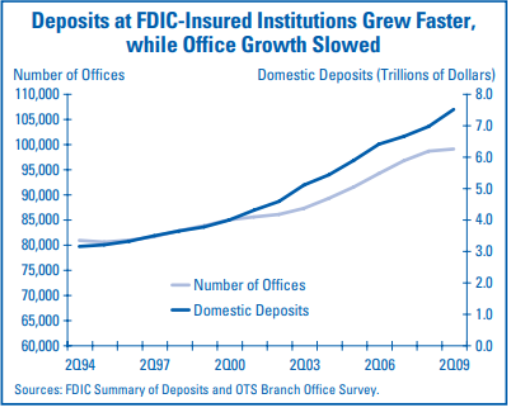
The FDIC and the Office of Thrift Supervision survey all FDIC-insured institutions to collect information on bank and thrift deposits and operating branches and offices each year as of June 30. The resulting Summary of Deposits (SOD) is a valuable resource for analyzing deposit trends and measuring market concentrations at the national and local levels. This article highlights findings from the 2009 SOF data, focusing on national trends in domestic deposits and banking offices but also present some information by state, metropolitan area, and institution.
Read article
The 2009 Economic Landscape: How the Recession Is Unfolding Across Four U.S. Regions
By Richard Brown (2009)
The following series of articles takes a closer look at the distinct way that this recession is playing out in four major regions of the country. The first article describes how the latest downturn is exacerbating long-term problems in the manufacturing sector of the Industrial Midwest. In the second article, we explore how formerly booming housing markets in Arizona, California, Florida, and Nevada have given way to a housing bust that has sharply reversed the momentum of the regional economy. The third article focuses on the impact of financial market turmoil on New York City and other financial centers along the East Coast, while the fourth article outlines why a number of states in the nation’s midsection have fared better than most thus far because of their high dependence on energy and agricultural production.
The 2009 Economic Landscape: Financial Sector Woes Pressure the Northeast
By Robert DiChiara and Kathy Kalser (2009)
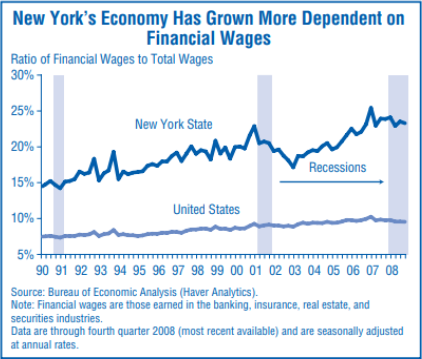
Contraction in the nation’s financial sector is magnified in New York State and particularly New York City— the nation’s financial center. Statewide, the contribution of financial jobs to total wages has increased in recent years. At its peak in 2007, wages from financial jobs accounted for 25 percent of statewide wages, considerably more than their contribution at the national level.
Alternative Financial Services: A Primer
By Christine Bradley, Susan Burhouse, Heather Gratton and Rae-Ann Miller (2009)
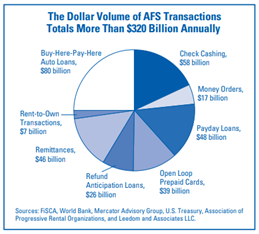
Alternative financial services (AFS) is a term often used to describe the array of financial services offered by companies that are not federally insured banks and thrifts. It sometimes also refers to financial services that are offered through alternative channels, such as the Internet or mobile phones. This article provides an overview of AFS and a description of the key products and services in this sector. It is intended as a primer for banks and others who are interested in understanding the competitive landscape in the financial services industry and exploring suitable opportunities in the AFS sector.
The 2009 Economic Landscape: The Sand States: Anatomy of a Perfect Housing-Market Storm
By Shayna Olesuk and Kathy Kalser (2009)
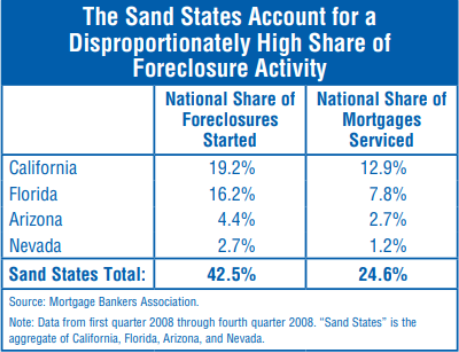
The historic boom and subsequent decline in the nation’s housing market has been a defining feature of the current recession. The housing downturn has been most acute in four states—Arizona, California, Florida, and Nevada— that had experienced some of the highest rates of home price appreciation in the first half of the decade. While these states are not all contiguously located, their similar housing cycles and abundance of either beaches or deserts have led some analysts to label them “Sand States.” This article discusses the factors that led to an expanding housing sector in these states and the market imbalances that culminated in a sharp correction in home prices. The article also explores the ripple effects that the housing downturn has had on the local economies.